
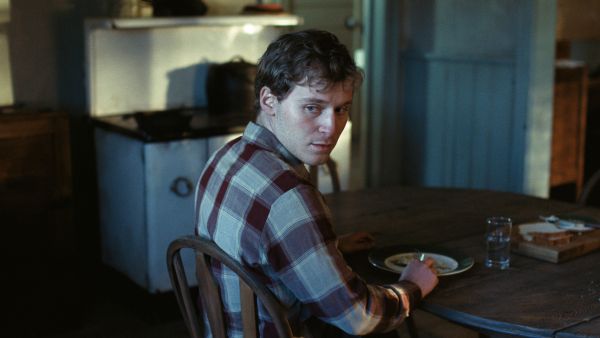
Like its source material, a 2006 short story by Colm Tóibín (recently published in hardcover with an afterword by its author), Andrew Haigh’s latest is a patient, beautifully crafted tale of repression and fractured family bonds in a remote, snowy setting. Haigh reimagines the characters and location, transporting Tóibín’s original Catalan Pyrenees setting to the Colorado Rocky Mountains (though the film was shot in the Canadian Rockies) while maintaining Tóibín’s subtle European atmosphere and mood.
Set in 1951, A Long Winter centers on Mike (Fred Hechinger), who is in his early twenties and somewhat aimless. He still lives with his father, Lester (Ebon Moss-Bachrach), his mother, Louise (Caitríona Balfe), and his younger brother, Tommy (Kit Connor), in a quaint cabin on a small farm. Haigh offers a few glimpses of this frayed family: An initial dinner scene is painfully silent and awkward—there seem to be fissures between the parents, and Mike eats too quickly, almost as if he wants to be finished with the meal and away from the table as soon as possible.
When going to town, Mike discovers that his mother, while claiming to be buying oil, is secretly drinking behind the family’s back with a few townsfolk in a backroom bar. Mike and his mother share a connection that the other two in the family don’t appear to have. When Mike is running errands, she asks him to pick up a magazine (an issue of Cosmopolitan that figures later in an interesting way) and not to tell his father, who considers magazines indulgent. Soon, Tommy goes off to serve in Korea. After Louise is confronted about her drinking by Lester, she suddenly disappears, right before a heavy snowfall that blankets the area for the rest of the season.
Haigh’s film is not plot driven, but rather an observational character study. In another story, Louise’s disappearance could be a potential true crime tale, but Haigh’s film (and Tóibín’s story) is murkier, never signaling that genre direction. Instead, we wonder: Did Louise intend to come back, is she coming back, and where did she go? These questions keep the viewer in suspense, though the film becomes more focused on Mike and Lester at the homestead.
Neither is particularly good at doing housework, which leads Lester to bring in Jimmy (D’Pharaoh Woon-A-Tai), an Indigenous worker who cooks and cleans for them. However, tension grows between Lester and young Jimmy, who appears to be about the same age as Mike, perhaps a little younger. Jimmy’s handsomeness, racial identity, and skill at housekeeping (including providing hot baths for the men) clash with Lester’s helplessness, ego, and machismo. Perhaps, too, Lester harbors an underlying suspicion that Jimmy could be gay, which he tests through bullying and taunting. As months pass and the snow very slowly thaws, both Mike and Jimmy become friends, while also maintaining a certain distance. (When sharing a room with two separate beds that Mike once shared with his brother, Mike asks Jimmy to move his shoes from the bedroom to the hallway—a subtle symbolic gesture of Mike exerting dominance and establishing boundaries.)
Mike’s repression is expressed elegantly by Haigh. In Tóibín’s subtle story, one often has to reread passages to figure out what is going on. Because of the visual nature of film, Mike’s sexuality is more explicit, though still extremely internalized and never vocalized. Before his mother’s vanishing, he sees a handsome junior police officer (Anthony Timpano) in town and is immediately drawn to him. The cop surfaces later when helping investigate, as well as in a brief erotic fantasy scene. There also seems to be an undercurrent of desire that Mike has for Jimmy as well. All of this is captured through brief glances that hold a tremendous amount of weight. Haigh is a master at this, as is his editor, Jonathan Alberts, a frequent collaborator.
The film is wonderfully cast. Hechinger has a youthful disposition for comedy, with a face that always seems on the verge of breaking into a smirk. (He was a great choice for the anxious, overprotected grandson in Thelma). That light touch ends up working well in this sympathetic, dramatic role, where his inner longings never feel too sullen or heavy-handed. Balfe, a standout in Kenneth Branagh’s Belfast, is even stronger here, shaping a character that could have been a typical ‘50s wilting-flower housewife. Her Louise is complicated: dreamy yet stubborn, with deep inner longings and an addiction that is upsetting to behold. Watching her listen to her 78 rpm record of the frothy tune “A Dreamer’s Holiday” sung by Perry Como and the Fontane Sisters (“Every day for breakfast, there’s a dish of scrambled stars”) highlights a fitting anthem for Louise’s impossible yearnings (indeed, Haigh usually nails the music cues in his films).
There’s a thorniness to Lester’s character, too; it’s not a one-note turn of male fragility. While tall in stature, Moss-Bachrach isn’t exactly imposing-looking. He’s lean and sinewy, with a softness in his striking blue eyes that belies his character’s mean mood swings and insults. The overall bitter repression Mike and Lester share, though in different ways, is well-executed by the actors.
Visually, the film is consistently stunning to look at, with vivid use of light and color photographed by André Turpin. Whether it’s the town with its shuttered theater—its marquee missing letters implying The Snake Pit (a 1948 film, perhaps suggesting how long it’s been closed, but also referencing mental instability)—the woodsy, intimate interiors; or the sweeping grandeur of the snowy landscape, the cinematography shines. Even if the film provides little in terms of resolution for the viewer and its characters, Haigh and his crew create an enveloping sense of unease, isolation, and quiet beauty.
A Long Winter will be released nationwide via Mubi in the United States on January 22, 2027.





Leave A Comment