Sometimes a particular kind of story, and the way it is told, can fall out of fashion for so long that when it reappears it feels almost like a revelation, even if dependent on the shadow of more emblematic and better-executed attempts from the past. The Weight is an immersive and effective film, but its hook loses some of its strength as it reveals itself as a minor mirage of those works to which it is indebted. Let’s just say that, enjoyable as the experience may be, it might be worth revisiting its most direct inspirations so as not to forget the real gold (The Treasure of the Sierra Madre, The Wages of Fear, or its much more intense remake, Sorcerer). On the other hand, such an association will immediately resonate for certain viewers as an invitation in itself: This is a movie you will indeed enjoy.
Thus, it is practically inevitable that the film will remain in constant dialogue with others that came before it, although these associations largely depend on the particular backgrounds of audiences as well as critics. Therefore, it would be unfair to dismiss director Padraic McKinley for taking notes from the masters (Huston, Clouzot, Friedkin) to enhance his premise: A handful of desperate convicts undergo a five-day expedition to transport a load of gold bars without losing a single one. Getting their freedom depends upon the successful completion of the dangerous—and likely designed to fail—task.
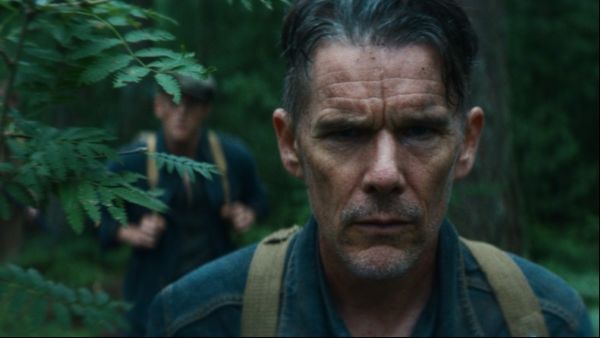
Set in 1933, during the Great Depression, the original screenplay (although inevitably derivative for the reasons outlined above) by Matthew Booi and Shelby Gaines, is initially strengthened by its empathetic portrayal of morally ambiguous men whose fate we eventually come to care about as their doomed expedition progresses. At the same time, it takes enough time to familiarize us with the characters before focusing on the central undertaking and the ensuing sequences charged with tension and adrenaline. Samuel Murphy (Ethan Hawke) seems to be the noblest and most astute of them, and therefore our default protagonist when, in the opening sequences, he is unjustly arrested for loitering at the wrong time and place. Because of this, he loses his daughter Penny (Avy Berry), who is referred to social services. So, he’s a wronged man with a fair motivation: to get out and get his daughter back.
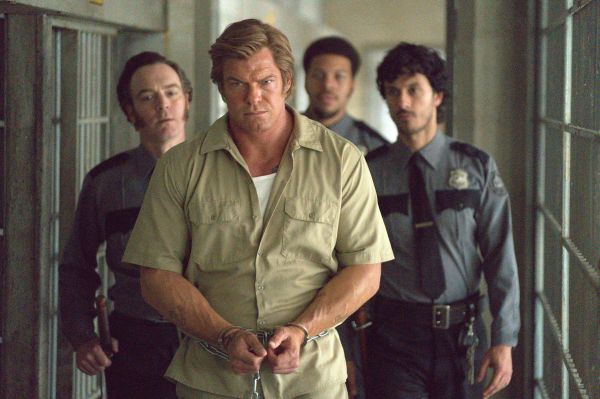
Four prison convicts, including Murphy, will get their freedom, a clean record, and some money, as long as they manage to transport a dozen gold bars through the impenetrable wilderness and forests stretching 100 miles across Oregon to a safe destination. There’s an upcoming law concerning confiscated gold, so a rich man is paying for it. It’s a deadly enterprise and should be executed in secret, so they must avoid any contact with those who would be motivated to rob the precious cargo. And there’s a catch: Two armed guards will watch over them to make sure the job is completed and nobody escapes, and if a single gold bar is lost, they will receive no reward whatsoever. So, over the course of five intense days, the group must face the forces of nature, as well as the individual and secret agendas among those involved that could compromise the mission.
Things won’t be as smooth as expected, naturally, but any potential “gold fever” tangentially alluded to is kept at bay, at least long enough, and thanks to this the journey remains in the spirit of the good, perhaps too good, Murphy. In what may be the best scene, there is a sort of homage to Sorcerer that maintains enough of its own identity not to feel like a blatant copy: A fragile bridge spanning a ravine cannot support the weight of the gold bars, so in order to transport them from one end to the other, Murphy positions himself in the middle to intercept each bar, one by one, and throw it to the other side. Certainly, the scene is every bit as tense as the one in Friedkin’s film in which a truck attempts to cross a wooden bridge that could collapse at any moment.
However, carrying gold is not as dangerous as Sorcerer’s nitroglycerin, and sometimes having a hero who is too good and too smart to behave recklessly works against the fun. Thus, The Weight ends up becoming a victim of its extremely delineated concept and rules that cannot be broken too early, which causes the inherent tension and unpredictability of potential scenarios to deflate. It becomes clear that some films too tightly bound to the model of their references can only settle for evoking danger without taking it to its full extent.






Leave A Comment