For those who came of age watching rented VHS tapes of the “Friday the 13th” and “A Nightmare on Elm Street” series at sleepovers with neighborhood kids, and who still hold onto a lingering nostalgia for those films, there is much to relate to in Jane Schoenbrun’s latest fantasia—a love story that includes the expansive lore of a fictional horror series, the 1980s-rooted “Camp Miasma” films, in the aesthetic vein of the “Friday the 13th” franchise.
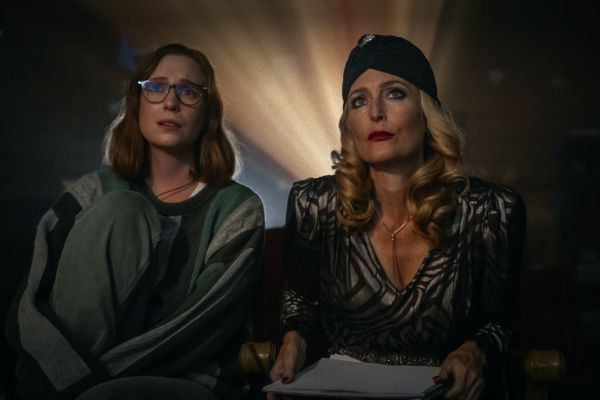
Young indie filmmaker Kris (Hannah Einbinder), a superfan of the “Camp Miasma” movies, is hired by a big studio to direct a reboot. Intent on adhering to its original style and roots before it became overly commercialized (now a “zombie IP,” in her words, primed to be resurrected), she travels to the wintry, remote setting where the first entry was shot (the actual location is unspecified, though it resembles the Pacific Northwest and was shot in British Columbia). She also hopes to rehire Billy Presley (Gillian Anderson), the first final girl of the series, who never appeared in another installment and, long retired from acting, lives now as a recluse deep in the woods on the site where the original movie was made.
The two characters both have confused, early sexual awakenings and traumas tied to the first film, Camp Miasma, and both are still stuck in that slasher-horror world as well: Kris in a chatty state of prolonged adolescent geekdom, Billy in quieter, jaded rumination (also sultry, with her vampy look and black turban hat, she’s a more self-aware, coyer Norma Desmond). So long removed from the real world, living in a roomy, remote cabin, Billy is a bit at sea (and perhaps not really ready to act again), whereas Kris is more ingrained in the realities of the everyday present.
There’s a new sense of precision in Schoenbrun’s work, but there’s also still joy and unbridled dreaminess. The opening credit sequence is astonishing in its dark humor and artistry, with a through-the-years montage of the lore surrounding the “Camp Miasma” series, its VHS tapes, its articles, merchandise, and paraphernalia (all crafted beautifully by Schoenbrun’s design team), as well as the slasher villain, the humorously named Little Death (Jack Haven, also in I Saw the TV Glow), who is shown evolving over time from a mythic cinematic icon to a wind-up toy.
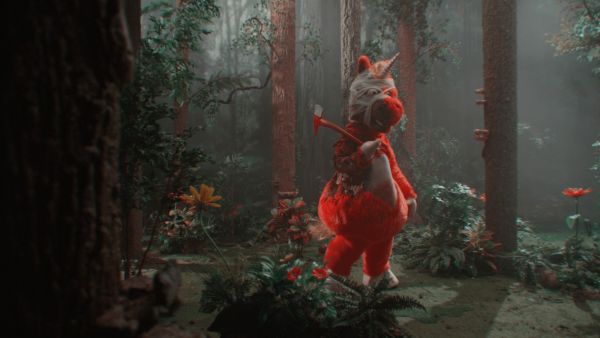
The film often recalls the oddball humor and tone of David Lynch’s Twin Peaks TV series, as well as its visual style, in which a Pacific Northwest setting somehow becomes otherworldly. Eric K. Yue’s lush cinematography, along with the occasional lavish, almost Wes Anderson–esque matte backdrops and visual effects, arrestingly captures Kris’s idealized world with the feel of a snow globe, while breaking into the bland realities of gas stations and Kris’s Zoom calls (involving her strained throuple relationship as well as apathetic studio cogs).
As in Schoenbrun’s I Saw the TV Glow, music plays a key role. Familiar songs are given new life and context. A haunting cover of R.E.M.’s “Nightswimming” by Okay Kaya plays over the opening. Two other songs—ubiquitous on American radio in the mid-to-late ’90s (music that would roughly trace back to Kris’s early childhood)—Counting Crows’ “A Long December” and Donna Lewis’s “I Love You Always Forever”—figure in pivotal moments. The meditative “A Long December” is particularly a strange cue, playing during a prolonged, blood-splattered murder spree of teens by Little Death. The lonesome lyric “one more night in Hollywood” echoes as the film reel of Billy’s original print of Camp Miasma spins, invoking a ghostly, elegiac feel for a bygone Hollywood era.
There’s a similar sense of joy and freedom in both Anderson and Einbinder’s performances. In Hacks, Einbinder’s growth and confidence as an actress over the series is undeniable. Her charisma lies in playing discomfort and awkwardness so well—her Kris feels organic, so human. Anderson is her opposite in style. It’s a studied, put-upon performance, with an exaggerated, loopy, honey drawl of a Southern accent. There’s both campy fun and humanity that Anderson brings to the part, and the two eventually work up incredible chemistry with one another.
Like other films in the vein, such as 1983’s Sleepaway Camp, the fictional Camp Miasma has its own issues with violence, misogyny, and transphobia. Schoenbrun seems to question what makes these kinds of films so impactful at a young age, especially for repressed, queer people. But the engagement with and deconstruction of these movies and their tropes is never heavy-handed or pedantic. Kris’s eventual newfound sexual euphoria in adulthood is funny, moving, and exhilarating. Under its cloak of slasherdom and horror, Teenage Sex and Death at Camp Miasma is, in a way, perhaps just a euphoric, queer romantic comedy.

Leave A Comment