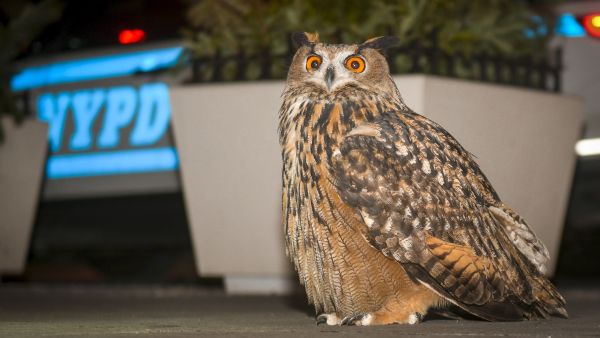
In February 2023, a 13-year-old Eurasian eagle-owl named Flaco flew out of his Central Park Zoo enclosure after an unidentified culprit cut its wiring. He spent the next year flying around the park and other areas of Manhattan, attracting worldwide coverage on newscasts and social media, as well as tourists and locals who cheered his every move, until he died the following February after flying into an Upper West Side apartment building.
This heartbreaking, cautionary tale is the subject of director Penny Lane’s absorbing documentary. Wild Inside recounts those events and explores how an owl that has spent its life in captivity finds itself in the wild and urgently needs to learn basic skills, like hunting and flying, while avoiding natural and man-made dangers. These hazards include ingesting poisons while eating pigeons and rats, which causes organ inflammation and leads to a fatally weakened state (which is what ultimately happened to Flaco).
In addition to news broadcasts and social media feeds, Lane constructs her film primarily out of footage from interviews with birders, owlers, and animal rights advocates who flocked to Flaco after he was first spotted on the pavement of Fifth Avenue. They then followed him during his months in Central Park, where he learned to fly and hunt. Central Park Zoo officials, after failed attempts to ensnare him, essentially gave up and allowed him to remain free in the wild—a decision applauded by most. Still, there were dissenting voices, like D. Bruce Yolton, a veteran birdwatcher who felt it was irresponsible of the zoo to stop trying to recapture the raptor. Yolton worried that being out in the wild would be extremely dangerous for Flaco’s survival, regardless of how quickly he acquired his new skillset.
The odyssey of Flaco riveted the city and the world; the documentary even features Flaco fans who have his image and name tattooed on their bodies. Lane also visits the World Bird Sanctuary in St. Louis, an organization that protects and preserves birds and their habitats. There, she speaks with Daniel Cone, who explains why a captive owl thrust into the wild overnight is in constant danger compared to those that have lived their entire lives in the wild. Members of the Wild Bird Fund on the Upper West Side, which provides care for and rehabilitates injured wildlife, also explain how the city’s unique challenges contribute to a high mortality rate for wild animals and birds.
The cross-section of New Yorkers interviewed includes Sarah Bramwell, who says that being a new empty-nester at the time made her feel very protective of Flaco. She later shows photos of the owl perched outside her window—a bit of serendipity that would be impossible to believe if she hadn’t offered proof. J.P. Borum (known as “the Bunny Lady” due to her fierce advocacy for the city’s abandoned rabbits) becomes part of the faithful crew of Flaco watchers who moved to whichever Manhattan neighborhood he was spotted in. This kind of affection for a wild owl is touching, but perhaps also selfish: it led to overflowing crowds watching the nocturnal Flaco, which may not have helped him adjust to his new lifestyle.
Although Yolton and Cone provide well-reasoned arguments as to why Flaco should have been recaptured and returned to the safety of captivity, Lane is clearly on the side of those who wanted him to remain free in the wild. She even gives one of them the last poetic word in this nuanced portrait of how a flight of fancy can slam into the unforgiving reality of an urban metropolis.


Leave A Comment