
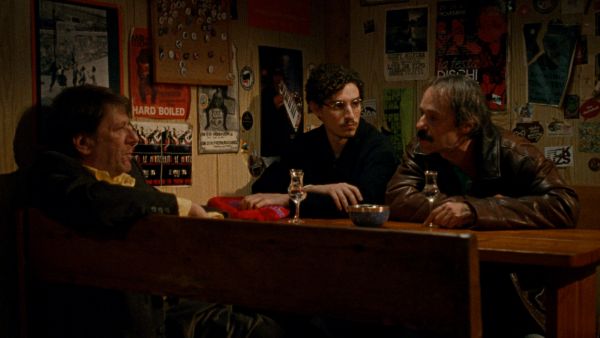
Say buongiorno to Carlo Bianchi (Sergio Romano), a walking pair of worried, sunken eyes pinned together above an unkempt black mustache. And to his pal Doriano (Pierpaolo Capovilla), whose cynical expressions unfold on a bloated facial landscape of pitted, leathery skin. They are the two irrepressible, inseparable, and irredeemable drunks at the center of The Last One for the Road. Francesco Sossai’s film is a woozy road movie, a wistful sketch of an Italy fallen from grace, and a wry comedy that, against all odds, holds out the possibility of cockeyed redemption.
The movie kicks off with a dramatic sortie in which an executive flies in by helicopter to honor a humble, longtime worker at one of his rural companies. He presents the overwhelmed honoree with a watch and fulsome praise in a crowd scene that plays out as a satirical, sinister fable—this portion will prove a clue to a puzzle later on. The narrative, seemingly randomly, then cuts to Doriano and Carlo Bianchi plotting their last call in a sad motorway bar after being cut off. In quick succession, they dodge police in their car to evade a likely drunk-driving arrest, then expertly cadge drinks from a party at yet another watering hole as Doriano butters up a woman over shrimp cocktail.
The string of events reveals how the duo operates: savvier and more efficient than they first appear and able to clean up their bedraggled exteriors convincingly in social situations (Italian tolerance for a smooth operator with a good scam helps). Actors Romano and Capovilla do a fine job conveying these seedy, pathetic, but resourceful and oddly gallant characters, and sharp dialogue shows off their world-weary, if squandered, intelligence.
This pair is always prowling for an easy mark, and they detect one in a bespectacled, diffident design student, Giulio (Filippo Scotti), whom they stumble upon at a boisterous graduation party in a college town. Giulio reluctantly turns down a young woman’s come-on because he has to go home and prepare for his design review, a plaintive protest he will fruitlessly utter multiple times throughout. Undeterred, Carlo Bianchi and Doriano whisk him off in their car for one of many supposedly last drinks and a road trip through the busted-flat byways of forgotten Italy.
What unfolds next is part on-the-road farce and part chronicle of opportunities lost. Carlo Bianchi and Doriano exchange somber confessions that belie their outward bravado. Background emerges on the 2008 financial crisis and how it helped reduce our antiheroes to their current sorry state. The men seek out dimly remembered restaurants and friends, finding both closed for business and old haunts deserted. A strange encounter combines con artistry with a weird gay angle out of left field, and a windfall alluded to in the opening sequence may not turn out as hoped. Meanwhile, their inhibited young friend starts to loosen up, getting into the groove of improvised travel and living by his and others’ wits. Giulio is learning a thing or two from these battered cavalieri, and when the time comes to part, the two sides will have both walked away with something of value, even if neither of them can quite say what it is.
The Last One for the Road occasionally dips into mentor-protege and beautiful-loser sentimentality, but the film benefits from an inner toughness and a clear but never sanctimonious view of the damage alcohol can do. Brisk transitions and a rough rock and indie soundtrack make this a more bracing experience than much Italian fare. For all its sadness, there is life in the old life yet, the movie seems to say: No matter how damaged you are, take hold of it while you can.

Leave A Comment