
From the start, the sustained creak of wood under friction and the faltering gasps leave little to the imagination until an image later reveals the source: a man agonizing on the gallows until he exhales his final breath. A statement of intent becomes clear: The sounds of sex can easily be mistaken for those of death. There’s nothing like a calculated provocation as an appetizer for what’s to come.
That is how “Wuthering Heights” (yes, with quotation marks) begins, the latest adaptation of Emily Brontë’s famous 1847 Gothic romance, this time filtered through the singular gaze and unsubtle touch of British director Emerald Fennell. (A closer shot reveals the corpse’s conspicuous erection urinating on himself.) Among the crowd, two mischievous children enjoy both the spectacle and their shared complicity: Catherine Earnshaw (Charlotte Mellington) and Heathcliff (Owen Cooper), destined to become the (anti-)heroes of one of the most celebrated and addictive romantic tragedies in literary fiction.
On the moors of Yorkshire at the beginning of the 19th century, Cathy and Heathcliff grow up together almost like siblings under the unstable care of patriarch Mr. Earnshaw (Martin Clunes), a drunk and gambling addict. Cathy’s legitimate brother, Hindley, is omitted here, but his cruelty shifts to the irresponsible and abusive Mr. Earnshaw. Though he’s generous enough to take Heathcliff in (the mystery of whether he might be his illegitimate child remains), he still treats him as a stable boy and punishes him in ways that leave his back permanently scarred. Cathy refers to the adolescent boy as her pet, yet he does not resent enduring humiliation and abuse so as to remain with and protect her against any potential punishment from the often enraged and miserable Mr. Earnshaw. An early oath in which he tells her she must never apologize and that he will always be there for her is tender and ominous. In due time, they grow into adults played by Margot Robbie and Jacob Elordi.
Robbie and Elordi share strong chemistry. They communicate the familiarity and complicity of two characters who know each other too well. When it rains, Heathcliff places his hands over Cathy’s forehead to shield her, and it is the most sensual image in the film up to that point. As in the novel, their platonic relationship and repressed desire are put to the test with the arrival of new neighbors at Thrushcross Grange. Edgar Linton (Shazad Latif) and his sister Isabella (Alison Oliver) inhabit a world far removed from the perpetually foggy and humid domain of the Earnshaws. They are also rich and not living in a house in progressive decay. Cathy resolves to visit them—even if it is improper for a lady—tired of waiting for an invitation from what could be a blessed marriage prospect or a life without poverty.
Her plan works even better than expected when she twists her ankle at the gates of the Linton mansion and is forced to remain there for several weeks to recover. For Edgar, the sight of this beautiful and vulnerable woman in his garden immediately awakens desire (and commitment), while the introspective and shy Isabella, a spinster in formation, is grateful for the chance to make a friend. The contrast between manors is reminiscent of Dorothy entering Oz. The grass could not be greener, dessert includes giant strawberries, dresses match the tones of walls and floors, and everything represents the possibility of a life previously denied.
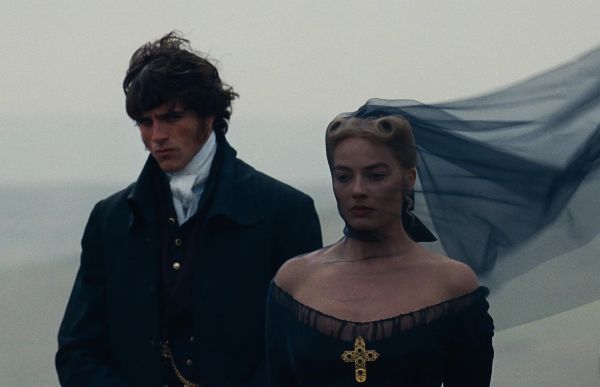
She returns home transformed and refined. A marriage proposal later, and a series of misunderstandings quickly create a rupture between Cathy and Heathcliff, and he leaves for good and she gets married. Cathy’s new bedroom is painted and decorated using her skin tone as a reference. The walls bear veins, moles, and sweat, while sinking softly when pressed. She is now a woman trapped within the contained desires of her own flesh. Fennell is an architect of subtext in plain sight, and this is her strength. Years later, when Heathcliff returns as a rich gentleman and turns Cathy’s world—and the Lintons’—upside down, everything is in place for the director to indulge the most disturbing and perverse possibilities of two selfish, capricious protagonists carrying a love capable of destroying everything around them, including themselves.
The result is not much of a twist but rather a pitch: What if the Brontë novel had more sex threaded through the darkness, starring two of the most beautiful actors in Hollywood, sparing us the frustration of Cathy and Heathcliff never being allowed physical intimacy, all without altering their fatal trajectory? Emerald Fennell’s “Wuthering Heights” is less a faithful adaptation than a stylistic appropriation: from a screenplay loaded with sexually charged scenes to Linus Sandgren’s lush (occasionally rococo) cinematography, Jacqueline Durran’s fashion-forward costumes, and a deliberately anachronistic production design, all while incorporating industrial sound-inflected original songs by Charli XCX. With echoes of classical Hollywood ambitions à la Gone with the Wind, and reminiscent of the experience of watching Coppola’s Bram Stoker’s Dracula, Luhrmann’s Romeo + Juliet, or last year’s Frankenstein by Guillermo del Toro, the source material is redefined at will. The gothic tale of a platonic, ghostly romance gives way to a carnal dark-pop nightmare dreamed in Technicolor. Both sensibilities—Brontë’s and Fennell’s—meet halfway: a romance turned cautionary tale of vengeance and comeuppance.
Why would an actress-turned-writer/director who has earned an Academy Award, and a reputation for original cinematic provocations, choose for her third film yet another version of a well-worn classic? Promising Young Woman and Saltburn remain among the most debated films of the decade. Her poisoned candies—a feminist revenge fantasy and an “eat the rich” psychological thriller fueled by gay, closeted longings—are not for everyone. Partly because—and her detractors are not entirely wrong—she cannibalizes hot topics (the #MeToo climate, class inequality) for shock value. Conversely, for some, it is impossible not to admire the visual richness of her impulses and excesses. If there’s room for one more adaptation of Wuthering Heights, perhaps there is no better candidate.
Fennell recognizes the hunger for genuine epic romance—something this decade has struggled to supply. In an age of increasing puritanism, no longer confined to one ideological pole, the decision to eroticize longing and reward yearning is highly effective and generous.








“introspective and shy Isabella”…who is actually made to look weird, desperate and grotesque.