Curtains up: Once more, with feeling!
After what could be considered the longest intermission ever, Wicked: For Good finally reaches movie theaters a full year after audiences were captivated by its predecessor, Wicked, both directed with care and passion by Jon M. Chu. That glossier and more alluring first part reintroduced us to the world of Oz and the complicated history of its good and bad witches. Both movies carry the weight of a monumental tradition, being based on the stage musical by Stephen Schwartz and Winnie Holzman, itself an adaptation of Gregory Maguire’s novel—which is, naturally, an alternative version of the story and characters created by L. Frank Baum. A tradition that also includes the most beloved of all adaptations: the 1939 musical film The Wizard of Oz, starring Judy Garland.
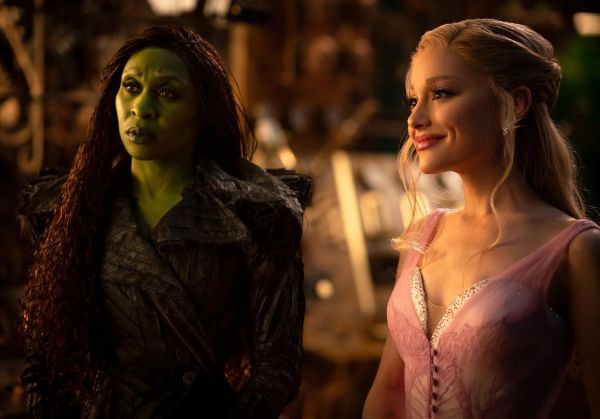
Right away, let’s get straight to what makes Wicked: For Good something more than a profitable, opportunistic strategy to secure double earnings. The decision proves creatively sound, deepening the material by turning a two-and-a-half-hour show into a nearly five-hour extravaganza. The year-long break helps audiences to fully embrace the transition from naive youthfulness to a compromised adulthood dealing with the consequences of choices for the two former best friends at the center of this saga: Glinda the Good (Ariana Grande) and Elphaba (Cynthia Erivo), now the Wicked Witch of the West. They now stand on opposite sides of the totalitarian regime engineered by the con man and Earth-born inventor who managed to fool an entire nation: the Wizard of Oz (Jeff Goldblum).
The green-skinned Elphaba is now a fugitive hiding in the forest, perfecting her magic through the magic spell book she stole from the Wizard. He and Madame Morrible (Michelle Yeoh) have successfully turned her into a boogeywoman of terror and evil, a threat to every citizen of Oz. This, in turn, allows them to advance their power-grabbing agenda of disenfranchising animals, who in Oz speak and possess consciousness but are now losing their abilities, locked in cages, or forced to flee toward a wasteland where most will not survive. The duo’s goal is to remain in power so the Wizard can’t be unmasked as someone who has no magical abilities at all. Their fascist administration is aided by flying monkey spies (a mutation Elphaba accidentally caused) and a state police force with fancy uniforms. Did you remember this is a fun musical? Don’t worry: Citizens across Oz will sing about how much they hate and fear the Wicked Witch and how beautiful the oppression is that keeps them in endless paranoia.
Only a few know the truth about Elphaba, though they are either too compromised or too comfortable to mount resistance. Glinda is the poster child of goodness, a celebrity riding around in a mechanical flying bubble countering the fear. Fiyero (Jonathan Bailey) leads the city guard and vows to arrest Elphaba before anyone else—though no one suspects he is secretly in love with her. He still accepts an engagement to Glinda, so that he may continue reinforcing the propaganda parroted by Morrible. In Munchkinland, Nessarose (Marissa Bode), Elphaba’s sister, serves as governor after the death of their father. She undergoes her own moral decline as she realizes that Boq (Ethan Slater), part of her old school group, will never return her love. She uses her authority to forbid any Munchkin from leaving without a permit, widening the rift between her and Boq, who is purposely affected by this measure.
Wicked: For Good plays out as melodrama at its most luscious. More than any action sequence, or the dazzling achievement of its production design and costumes, the highlight is the reunion between the old friends as they reconcile or clash, depending on circumstance. (There’s even room for a ridiculously funny catfight.) The chemistry between Erivo and Grande remains electrifying, building to a heartbreaking conclusion. The songs, meanwhile, are less eager to burst into spectacle, and when they do, a heavy undercurrent of suspicion lingers (as in “Wonderful,” reworked as a trio to include Glinda alongside Elphaba and the Wizard).
Here the musical numbers serve a more urgent purpose: sharpening the complex relationships among the characters and the inner turmoil consuming them. Chu leverages the weakness of the second act songs by transforming them into moments of greater intimacy, allowing his performers to raise the emotional decibels. Erivo singing “No Good Deed,” while surrounded by flying monkeys, or “No Place Like Home” (one of two new songs written for the movie) as she urges the fleeing animals to stay and fight, are crafted with dramatic exuberance and the perfect blend of vulnerability and empowerment. Meanwhile, many will agree that the romantic duet “As Long as You’re Mine” between Elphaba and Fiyero remains as thrilling and arousing as anything in the previous film.
As you might guess, the final chapter represents a non-uplifting tonal shift compared to the first installment. Will audiences respond as they did before to darker material and songs offering less easy enchantment? We can only hope they are ready to be rewarded with something affecting—a reminder that difficulty and oppression can arise even in the so-called wonderful places. Calling this a political film might be an overreach, but it does contain important warnings expressed with effective simplicity in blockbuster mode, capable of making audiences of all ages consider their surroundings and what the future holds. Wicked: For Good shines this time with shadows. There’s no place like home, until we forget that home is supposed to feel safe and welcoming.
Leave A Comment