
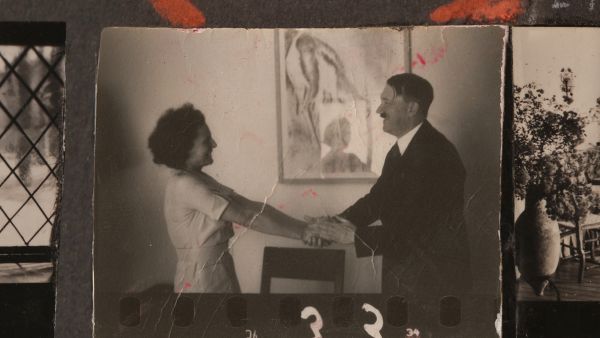
The moniker “Hitler’s favorite filmmaker” was a label Leni Riefenstahl dealt with her entire life. (And what a life it was. She died at age 101 in 2003.) As Andres Veiel’s unsettling and persuasive documentary points out, Riefenstahl spent decades trying to accept the accolades for her technically brilliant Nazi propaganda films while vehemently denying she was complicit in the Nazi regime’s horrors or, at the very least, a Hitler apologist.
Riefenstahl rehabilitated her reputation somewhat late in life, publishing her autobiography in Germany in 1987 (an English translation came out five years later) and commissioning a 1993 documentary: Ray Müller’s three-hour The Wonderful, Horrible Life of Leni Riefenstahl. Veiel deftly uses footage from that film and also employs a voluminous amount of material from Riefenstahl’s personal archives—unfinished scripts, memoir drafts, personal letters, and photographs—that provides further evidence of her distortions of the truth.
Veiel concedes that Riefenstahl was a pioneering director at fetishizing physicality, whether it was Nazi soldiers marching in lockstep in front of Hitler in Triumph of the Will (1936), which chronicled a huge Nazi Party rally in Nuremberg, or Jesse Owens breaking world records and winning gold medals in track and field in Olympia (1938), a film about the 1936 Berlin Summer Olympics. While Riefenstahl always maintained that her visual aesthetic of physical beauty was apolitical and not fascist, despite its uncomfortable closeness to the Nazi Aryan ideal, her complicity with Hitler and his inner circle remains.
Veiel shares a startling moment from Müller’s film in which Riefenstahl yells in outrage when reminded of Goebbels’s diary notes. The entries reveal that she was a close enough acquaintance to visit him socially, despite her earlier claim that he was not her “type.” She reiterates her talking points, claiming she was just an artist not aligned with National Socialism and that she did not know about the horrible atrocities in Germany and elsewhere, from burning books to concentration camps. Her claims sound opportunistic at best, and at worst, a forerunner of fake news, as she either denies the facts or says she was simply naive. She even exclaims at one point, “I am not responsible for what happened!”
Another illuminating clip, from a mid-1970s German TV news program, features Riefenstahl in an interview with another woman her age. As Riefenstahl insists there’s no way anyone could have resisted Hitler and the Nazis, the other guest, an ordinary German woman, vehemently disagrees, her loathing for Hitler ensuring she would not have done what Riefenstahl did personally and professionally. Following the telecast, Riefenstahl received a huge positive response in the form of letters and phone messages from West Germans irate that she was attacked. One male supporter says, “Justice will prevail in the end.” Veiel never explicitly draws parallels to the rise of the right wing in Europe and elsewhere today, but he does not have to. Riefenstahl’s still troubling story remains a relevant cautionary tale.








Leave A Comment