Observing the tense interplay among professional musicians, Grégory Magne’s film is a dryly humorous account of a wealthy heiress who fulfills her music-loving late father’s dream: She assembles a quartet of renowned players to perform the work of composer Charlie Beaumont (Frédéric Pierrot), a favorite of her father’s.
Astrid Thompson (Valérie Donzelli) secures both the musicians and their instruments—two violins, a viola, and a cello, all Stradivarius and worth millions. The lineup includes Peter (Daniel Garlitsky), a veteran classical superstar; George (Mathieu Spinosi), a younger hotshot violinist; cellist Lise (Marie Vialle), the hardest to recruit due to a romantic and professional split with Peter years earlier; and violist Apolline (Emma Ravier), the youngest yet their equal in skill. Nevertheless, Apolline feels looked down upon for her success, achieved without attending music school, unlike the others. (She’s played Carnegie Hall and has 700,000 Instagram followers).
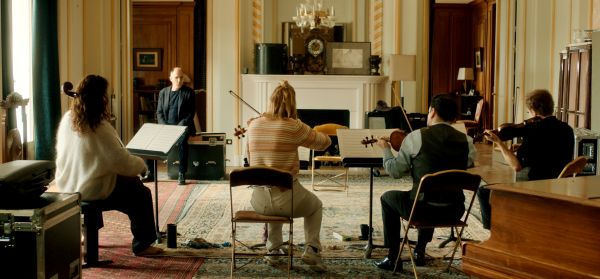
Astrid houses the musicians in a rural castle for a week of rehearsals while the nearby church venue is prepared. She persuades Charlie, the initially reluctant composer, to coach them so they can better grasp his complex piece. He warns that, however talented, four musicians thrown together can’t match the cohesion of a long-standing quartet.
Much of the drama—and comedy—comes from personality clashes: Peter and Lise’s frosty history, George’s tendency to dominate and criticize, particularly Apolline. When George storms off after a rehearsal spat, Charlie takes it upon himself to lure him back. Later, a bout of horseplay between George and Apolline damages his priceless violin. Fortunately, it’s repaired in time for the concert.
The movie is proudly conventional, and the stakes remain low. Even setbacks, like a blackout caused by George’s ill-advised hot-tub repair, quickly turn into moments of bonding—here, a wine-fueled singalong of Lead Belly’s “Where Did You Sleep Last Night?” that gradually draws in the whole quartet. Donzelli’s sympathetic Astrid and Pierrot’s delightfully eccentric Charlie anchor the ensemble, while the four musician-actors bring both dramatic credibility and authentic musicality to the screen.
French composer Grégoire Hetzel wrote the fictional quartet at the film’s heart, its minimalist strains recalling Philip Glass or Michael Nyman—modern and plausibly challenging to play. Magne’s film radiates a genuine love of music. Whenever the foursome launches into Hetzel’s score, the harmony of their performance, the cinematography, and the visual rhythm convey the exhilaration of making music together.






Leave A Comment