
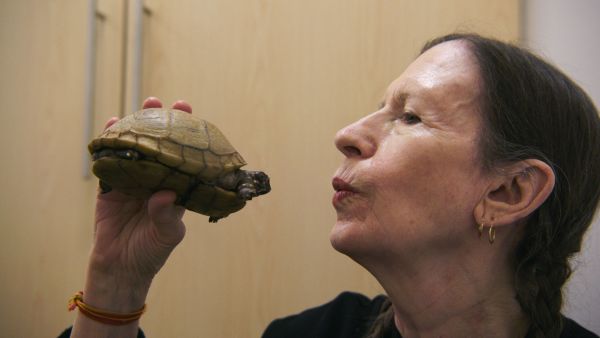
Right before the end credits in the documentary Monk in Pieces, octogenarian artist Meredith Monk remarks, “This is a song about an old woman bargaining with death. It’s a comedy.” The quip is vintage Monk: dry as a sheet of typing paper, yet still witty and weirdly optimistic. Filmmaker Billy Shebar has created a moving portrait of the innovative choreographer, dancer, singer, and filmmaker—one that mirrors her own creations in its flowing, loose-limbed rhythms. The far-ranging profile also celebrates her sharp mind and tenacity.
Loosely grouped with Philip Glass, Robert Wilson, and early boyfriend/collaborator Ping Chong, Monk was part of the now-revered wave of creativity that emerged from a grubby, scary New York in the 1970s and ’80s. (Laurie Anderson and Yoko Ono are two other contemporaries who might belong in the comparison.) Archival footage from the period shows filthy streets and eccentrics performing kooky dances. It’s easy to see why Monk drew inspiration from such an environment, but her gumption propelled her far beyond the post-hippie scene.
Although she works in many disciplines, Monk is perhaps best known for her musical yet nonverbal sallies—chanting, keening, and singsong patterns. In her work, dance and voice share a quality of undulation and flexibility. It’s easy to caricature or mock Monk’s output; mostly male critics initially ignored her or dismissed her with contemptuous write-offs such as “a disgrace” or “simple-minded.” In fairness, her work can be confounding—at first.
Monk’s aural performances may appear random to the unaccustomed ear and eye, but the artist brings a remarkable rigor to deconstructing speech and creating new forms of sound. In a fascinating sequence, the filmmakers superimpose Monk’s face—or parts of it—into geometric squares and rectangles as she discusses her process at different stages of her life. It’s an apt metaphor for the sonic structures Monk constructs, the discipline she brings to her practice, and her belief that “most artists have one story they’re telling over and over again in different ways.” Artists and collaborators like Chong, David Byrne, and Björk praise her inspiration and the unconventional ways she weaves sound and vision together.
Monk in Pieces highlights a wide array of Monk’s operas, films, and stage performances—each smart, inspired, and symbolic. Just as compelling is Monk herself. Casually charming, confident, and straightforward, she’s a natural conversationalist who draws the listener in. The stoic sage also bears life’s scars. Monk mourns her mother, a jingle singer who succumbed to depression when her career declined. Frustrations mounted after early critical rejection. A beloved partner died. And one can’t help but feel a pang of sympathy seeing Monk in her loft apartment, alone.
But then she’ll chuckle that she had “the time of her life” getting an MRI, encased in a tube and bombarded by bizarre noise. Or casually mention that the Dalai Lama once told her she should make a piece around the sound of clicking teeth (she did). And we watch as she proudly receives the Medal of Honor from President Obama, both beaming at the podium. Monk clearly knows not just how to laugh, but how to get the last laugh. Along with her artistic daring and perseverance, it’s given her quite a life—a life that, in turn, has given so much to the imagination.





Leave A Comment