
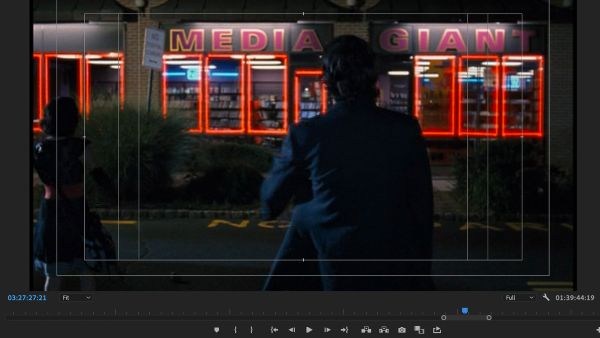
How many of us who grew up with video stores assumed they were here to stay? Until the advent of Netflix, I recall their permanence being more or less taken for granted. That vanished assumption is hard to reconcile with the speed of their disappearance and the seeming lack of sadness from customers, both during and after their demise. Those of us who miss them, who still prefer to browse in a brick-and-mortar location among a collection of physical media, are often written off as nostalgic.
Director Alex Ross Perry clearly misses them too, and yet in his nearly three-hour documentary Videoheaven, he refrains from overtly gushing or portraying them as ideal. His premise is simple: Video stores are not only gone, they’re impossible to visit. (The few surviving ones are mentioned only fleetingly, and never by name.) The only way to “visit” them now is through their depictions on film and TV, because that’s the only place they still exist. This is how those who were not there might get a sense of what they were.
It’s a surprisingly fruitful approach, helped greatly by Maya Hawke’s narration, which provides historical context for the industry’s development. The film offers startling statistics on the rise and fall of stores, VCRs in homes (6.5 million in 1987), DVD players, and more. This data enables Perry to explore what video stores meant, how they were represented on film and TV, and how that representation evolved. In early depictions, when videotapes themselves were still new, a store could appear as “an archive of unfathomable depth,” but also as a place unhinged and dangerous. (Videodrome and numerous B-movies feature sci-fi takeovers via video store.)
Gradually, the Blockbuster chain rose to power, and independent stores began to struggle. Perry devotes time to the tension between Blockbuster and indie businesses, VHS vs. DVD, the battles over late fees, damaged discs, and awkward or unwelcome encounters. Included are portrayals of video store courtships, run-ins with exes, and arguments with phlegmatic or snobby clerks. One of Perry’s sharpest and funniest insights is that one’s movie choices were always, to some extent, public. (I had completely forgotten the feeling of running into a high school classmate and wondering if they’d inspect my movie pick.) This angle becomes especially relevant in the section devoted to the prototypical backroom—full of porn.
Perry’s meticulous analysis of the selected clips is frequently rewarding, and the film’s greatest strength may be his refusal to idealize the past. He clearly misses it, but he doesn’t portray it as a time of perfect harmony. Often, he wonders why so many films depicted video store clerks as unpleasant, and the store environment as full of unhappy interactions—he hints that he knows this was only a partial picture.
Which brings us to the film’s greatest limitation: Is representation really the only way to talk about what video stores were? Does it help us understand what made them special? As much as I admire this film, I find it unlikely that a viewer who didn’t experience video stores firsthand would truly grasp the magic—of encountering not the film you were looking for but the one next to it; of kind clerks whose taste you trusted and whose recommendations you’d follow; of the spontaneous delight of running into someone you knew; of the many ways a curated, physical selection differs from the hellscape of infinite online content and the mind-numbing rot of algorithmic suggestion.
A real depiction of that might prompt audiences to ask whether what’s happened since really is “progress,” and whether our desire for similar spaces now truly is nostalgia. One of the great things those stores offered was, writ large, the unexpected, and that’s increasingly rare when you’re sifting through a streaming platform tailored to your search history.
When video stores went under, I was genuinely angry. Many of my happiest hours had been spent in them. I couldn’t believe people would forsake independent businesses just to stay home. I feared that great movies would vanish if physical media weren’t maintained, that the advent of streaming services would create a glut of lazy content, and that the internet’s worst tendencies would take over in much vaster quantities than the home video market ever produced. Roughly a decade later, I still believe I was right. And if you ask why I check so many DVDs out of the library instead of streaming them, my answer is simple: freedom. And I’m guessing there are others who feel the same. Not far from where I live now, a new video store is opening.
Perry’s film is a fascinating endeavor, full of unlikely insights. but he may have been able to transport us farther than the limits he set for himself.






Leave A Comment