
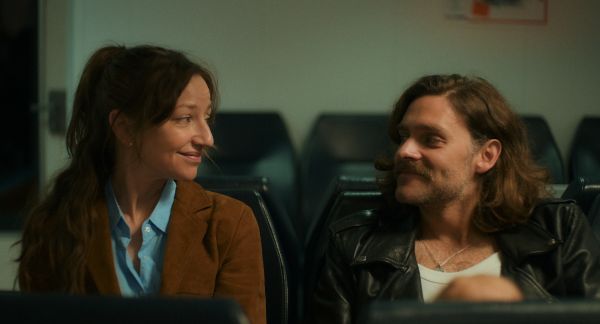
A city you’ve lived in your whole life—or a person you’ve known for a long time—can feel both familiar and unrecognizable at once. But the latter is something you may only realize when you least expect it. In Dag Johan Haugerud’s Love, these moments are pivotal for the characters as they reassess their relationships with the city they inhabit—Oslo, in this case—and with the people in their lives, or those they might allow in.
One early scene features a woman leading a group as if they were tourists learning for the first time about the history of certain buildings or statues, amazed to discover that many are monuments celebrating sexuality and diversity in plain sight. But in reality, the group consists of members of the city’s Department of Culture, led by a person appointed to oversee the project commemorating the city’s anniversary. Among the listeners is an outsider: the guide’s best friend, visibly surprised—though we only understand this fully in later scenes—by the boldness of someone she’s always known to be rather conservative and rigid.
From the very beginning—starting with a prostate cancer diagnosis delivered with precise tact—Norwegian director and screenwriter Haugerud presents himself as a careful observer of human nature. His script is filled with experiences deeply specific to a time and place, yet universally relatable. Lived-in moments and conversations sharply sketch out two main characters: Marianne (Andrea Bræin Hovig), a urologist, happily single and carefree; and Tor (Tayo Cittadella Jacobsen), a nurse who is equally single and independent. Both work at the same hospital. She is a straight woman; he is a gay man. They develop a growing friendship—at work and during off-hours—enriched by candid conversations that unveil their respective quirks and desires when it comes to sex and relationships. The result is a thoroughly modern portrait of experiences often mediated by dating and hookup apps, along with reflections that challenge conventional notions of what is acceptable or traditional today.
That initial cancer diagnosis scene also lays bare some fundamental differences between Marianne and Tor, personally and professionally. Marianne is convinced of the need to create a space of trust and honesty when delivering such life-altering news. Tor sees a bit further—he knows some men are afraid to ask certain questions. Later, in a similar situation, Tor explains to Marianne that many of his patients are gay men, and that one of the unspoken truths about prostate-related treatments and surgeries is the loss of pleasure specifically tied to anal sex. This kind of frank, unfiltered dialogue highlights one of the film’s core strengths: sex is presented not only for its eroticism but for its human depth.
Meanwhile, Marianne is acutely aware of the societal expectations and judgments placed on women who remain alone after a certain age. She’s not opposed to being in a relationship, but it’s not something that keeps her up at night, unlike her best friend, Heidi (Marte Engebrigtsen)—yes, the same guide from the beginning of the film—who seems more concerned about Marianne finding a steady partner. Her efforts to set her up with Ole (Thomas Gullestad), a divorced geologist, are successful, though Marianne is initially hesitant about getting involved with a father of two whose ex-wife lives next door. Yet the chemistry between Marianne and Ole is easy and natural, both in bed and in the pre- and post-coital conversations.
Still, Marianne feels a twinge of envy toward the freedom Tor describes in his experiences. He regularly rides the ferry, where he connects with other men via Grindr and often engages in quick sexual encounters during the ride. Inspired, Marianne tries out Tor’s strategies using Tinder—also during a ferry ride—with mixed results: She ends up hooking up with a man who only afterward admits he’s married. For his part, Tor meets an older man who resists his charms, Bjorn (Lars Jacob Holm), a psychologist from a different generation of gay men who grew up in the shadow of AIDS and carries a more cautious demeanor. Future meetings hint at a semi-platonic relationship between them, but in Haugerud’s universe—as in real life—nothing is ever that simple or easily defined.
Like an unlikely heir to Eric Rohmer and Woody Allen, Haugerud’s poignant perceptiveness as a writer does not overshadow his visual sensibility as a director. He translates ideas into effective images with an enveloping pace. It helps that the Oslo landscape is more than just a backdrop—it’s a third protagonist: vibrant, appealing, and full of contradictions. It’s also worth noting that this film is one of three parts in a thematic trilogy titled “Love, Sex and Dreams.” However, the sequence—by title, festival premiere, or commercial release—is non-canonical and varies. In any case, this is the “first” entry available to U.S. audiences, and it’s an opportunity not to be missed: an invitation into a distinctive cinematic universe that is as stimulating for the mind as it is for the senses.





Leave A Comment