
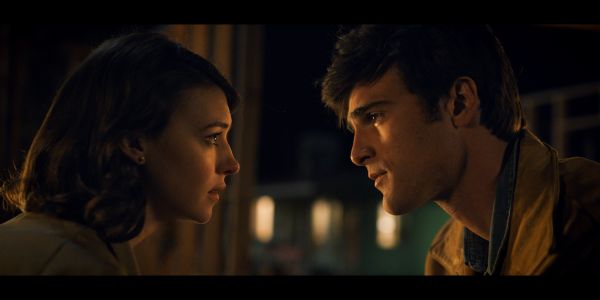
There’s something enveloping, charming, and comforting about the sturdy, old-fashioned Hollywood feel of Daniel Minahan’s On Swift Horses. Adapted by Bryce Kass from Shannon Pufahl’s 2019 novel, the 1950s-set drama moves in and out of the lives of Muriel (Daisy Edgar-Jones), her boyfriend Lee (Will Poulter), and Lee’s brother, Korean War vet Julius (Jacob Elordi), across an array of mostly American Western locales.
We first glimpse the characters coming together as Julius, back from Korea, visits Muriel and Lee at her late mother’s family home in Kansas. From the beginning, there’s a strong, inexplicable bond—a simmering electricity and a sense of closeness—between Muriel and Julius as they meet for the first time.
Mostly at Lee’s urging, he and Muriel leave Kansas for California to get married and start anew, while Julius drifts from place to place as a gambler and sex worker, eventually settling in Las Vegas as a surveillant in the stifling rafters of a casino. Julius and Muriel exchange letters (read via voice-over), though it’s sometimes unclear whether these letters are always received and read. Muriel works as a diner waitress while covertly wading into horse track gambling, eavesdropping on customers’ tips. She hides the money she wins from Lee, perhaps saving up for an independent life of her own away from him. (Coincidentally, Edgar-Jones also played a character with a deeply rooted Midwestern past in last year’s Twisters.)
The film slowly reveals both Muriel and Julius’s explorations of their queer identities. Muriel begins a flirty affair with her neighbor Sandra (Sasha Calle), while Julius falls in love with a co-worker, Henry (Diego Calva). Without the burden of hiding from a married partner, Julius and Henry’s relationship—lived out in a tiny, shared room—is particularly steamy. The portrayals of queerness in this period are vividly evoked, including a rollicking party at Sandra’s house and a tense moment in a clandestine bar, where lights are flicked off to warn same-sex patrons of nearby cops.
The cast is quite appealing. Edgar-Jones delivers a strong yet quiet performance that communicates Muriel’s inner ticking—her latent restlessness for a new life. As in Emerald Fennell’s Saltburn, the camera is once again enraptured by Elordi—his Julius constantly flaunts a taut, lanky physique, including an early shirtless appearance. His performance, however, is sometimes muffled, his accent wavering. (At one point, he suddenly sounds like Elvis again from Sofia Coppola’s Priscilla.) The uneven portrayal nonetheless suits a closeted character trying to figure himself out. Chain-smoking through his interior torments, with a mop of dark hair and an elegant, thin frame, there’s an air of Montgomery Clift about him.
The supporting characters are mostly sidelined by Julius and Muriel’s dramas. In what could have easily been a one-note, antagonistic role, Poulter imbues Lee with sympathetic earnestness. Poulter is 6’2”, yet his character feels small—almost juvenile—because of his obliviousness to what his wife and brother are up to. As Gail, a cool, coy blonde who locks eyes with Muriel at a horse race, Kat Cunning swoops into just a few scenes that rank among the film’s best, including delivering its key line: “We’re all just a hair’s breadth from losing everything.” Calle and Calva are both solid, though their romantic arcs feel somewhat rushed and underdeveloped.
Although this is Minahan’s feature debut, he brings an impressive list of television directing credits, including Six Feet Under, True Blood, and the similarly themed miniseries Fellow Travelers. His direction here is plain but robust, capturing period detail and multi-character storylines through smooth, nimble editing (by Joe Murphy, Robert Franzen, and Kate Sanford) and picturesque photography by Luc Montpellier—working with a more invigorating and colorful palette than his stark, washed-out cinematography in Women Talking. The art direction is striking too; the backdrops of new model homes under a burnished sun, being constructed all around Muriel and Lee, are particularly arresting. Mark Orton’s score (a frequent collaborator with Alexander Payne) veers between sentimental and florid, then scrubby and rockabilly. It reflects the film itself—attractive, though occasionally wobbly—a mix of conventional Hollywood gloss and scrappy, lusty, unbridled rebellion.



Leave A Comment