
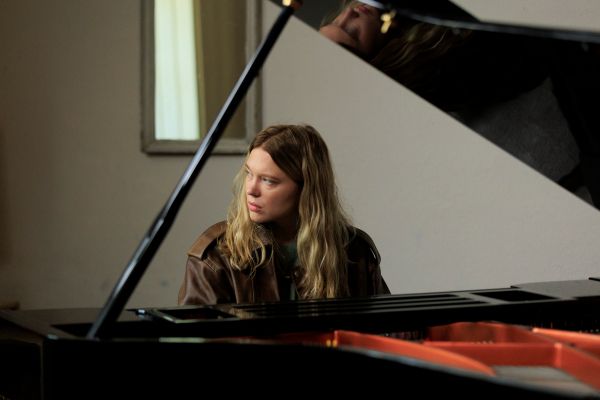
How do people respond to the horrific? How are they to deal with the information once it has been unearthed? Certainly, there are the clichéd screams we’re used to from so many movies, and the equally routine righteous speeches. Most of us, I’m guessing, would like to think that we would do the right thing; perhaps we’d also be smart enough to know what the right thing is. Gentle Monster, an engrossing new drama from director Marie Kreutzer (Corsage), brings us into the life of a wife and mother who cannot easily extricate herself from a nightmarish reality.
Lucy Weiss (Léa Seydoux), a successful musician, has moved to the German countryside with her filmmaking husband Philip (Laurence Rupp), and their seven-year-old son Johnny (Malo Blanchet). Their days could be described as idyllic, with Lucy at the piano, Johnny jumping on the backyard trampoline, time for sex when the kid is at school, and time to sing and joke as a family, but cracks emerge quickly. In the middle of Lucy’s practice session, Philip is heard gasping—Lucy runs immediately to him. He is sobbing, apparently from nerves. She calms him effectively, then returns to playing the same song.
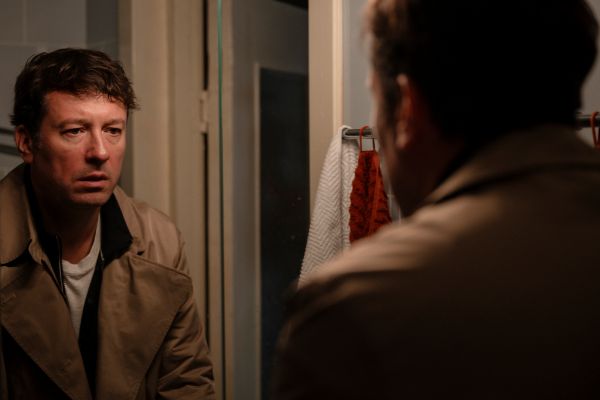
Hints of a darkness we cannot place continue until the police arrive with a search warrant, asking for Philip’s computer and flash drives. When Lucy arrives at the station, she finds out bluntly the cause of the search: possession, and perhaps even the making, of child pornography. Her first instinct is to get Johnny away from him, and she whisks him away to the home of her mother (Catherine Deneuve).
Though this film contains a few hackneyed lines, and you could argue that Philip himself speaks in clichés (they’re what’s available to him when he tries to win Lucy back), it is overall skillful, thought-provoking, and very assuredly directed. Writer-director Marie Kreutzer approaches her material with incredible patience, nuance, and realism. With beautifully composed frames, careful observation of seemingly mundane occurrences, and silent scenes rife with tension just barely subdued, she allows the story to progress at a stately pace and speak for itself. By the end, the viewer is stunned by how many layers of horror have accumulated.
With clear-mindedness and dedication to complex characters and equally complex problems, Kreutzer expertly interrogates the ramifications of her characters’ actions. A side-narrative, involving the police officer Elsa Kühn (Jella Haase) and her attempts to deal with her lecherous yet senile father, creates a fascinating counterpoint to Lucy’s struggle to find the truth about her husband: both women are, in essence, working to manage their complicity in different situations of sexual abuse. And with a near-labyrinthine structure of revelation and reevaluation, the film forces us to scrutinize all the information available as closely as Lucy does. All the acting is very strong, and Seydoux especially creates Lucy’s emotional state with a masterful hand.
Perhaps greatest of all is the sense of ambiguity at the end. The crime is certain, but the full scope of it, and all the specifics of it, are chillingly unclear. We are left, as Lucy is, still working to figure out what must be done.





Leave A Comment