
Star Trek famously described space as “the final frontier,” but one could make a similar case for parenting. Being a parent means raising your child to be the best person they can be, even if this means there will come a day when the kid will “boldly go” into the world on their own. Or in Space Cadet’s case, going far beyond Earth’s atmosphere, yet carried back there by the surrogate memories between a young woman and her robot guardian.
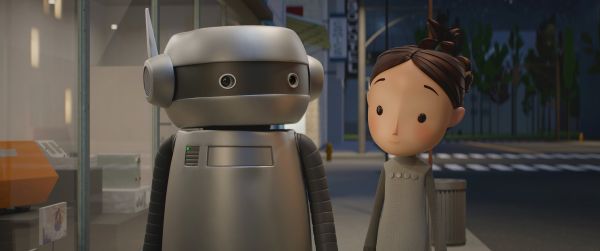
Space Cadet is a tale of family and memory, but also grief and loss. Told straight from the heart by director and scratch DJ Kid Koala (real name Eric San) in this adaptation of his 2011 graphic novel, the animated film is without dialogue, yet conveys so many emotions across every frame. The cadet in question is Celeste, a woman following in the footsteps of her late mother, an astronaut who never made it back home from her last mission. Since losing her, Celeste has been raised by Robot, a lifelong companion bot who has helped prepare Celeste for space travel from childhood to graduation day. Flashbacks detail the small moments that make up Celeste and Robot’s bond—all stored as video recordings in Robot’s memory bank—from a school theater performance to watching Celeste’s mom teach her how to play musical instruments. It might not be flesh and blood, but those memories give Robot a purpose beyond basic programming.
Eventually, Celeste is given a six-month mission in outer space, and the duo must reckon with being apart from one another. For Celeste, this means focusing on her goal of researching alien plant life. For Robot, that means finding a purpose beyond caretaker, which it attempts to solve through painting still objects. But trouble eventually rears its head. Robot’s memories of the past begin to interfere with its programming in the present, an issue that could be solved at the expense of a complete memory wipe. A detour to a planet in wild space, meanwhile, leaves Celeste unable to leave its surface lest her ship get attacked by hostile alien life, forcing her to rely on her wits and parental teachings to find a way home.
Anyone who has had a parent or guardian can easily relate to Celeste’s strong bond with Robot, whereas anyone who has been a parent can empathize with Robot’s struggle to hold onto positive memories despite malfunctioning. Yet simplicity is the name of the game when it comes to Space Cadet. The film depicts these mature themes through easy-to-understand scenarios that straddle a line between grounded and fantastical. This is, after all, a world where robots coexist with humanity as housekeepers and caretakers.
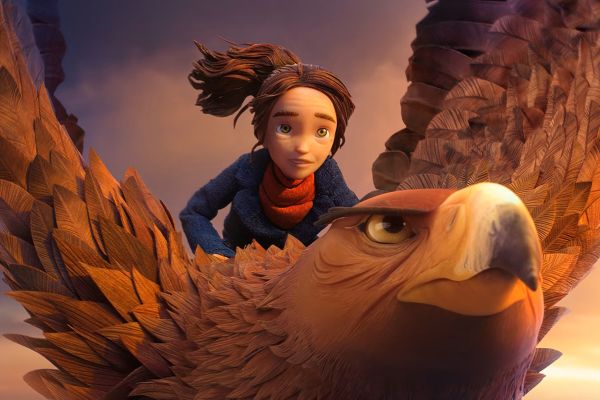
As the film goes on, it definitely puts more focus on Celeste’s intergalactic struggle, with Robot’s spiral back on Earth receiving only frequent mentions. Thankfully, both halves are animated in a CGI style that can best be summed up as “really freaking cute.” Blending stop-motion-inspired movements and doll-like character models, there’s an innocence and minimalism to the animation that is always gorgeous to look at. Goofy and wholesome memories play out alongside the serious, heartbreaking moments without feeling like any one scene breaks the immersion.
Canadian animation studio Outsiders Films does a stellar job making these characters look utterly adorable. Space Cadet has moments of action, like piloting a spaceship to a zero-G martial arts battle with an alien, but its heart lies in the smaller, quieter memories—moments that feel innocuous on a big-picture level. However, they link Celeste and Robot across light years, which plays into the movie’s final sacrifice, a move that can be read as either tragic or another necessary step in growing up.
Space Cadet’s message will strike a chord around the world, thanks in part to its embrace of nonverbal storytelling. It might venture beyond the stars, but Kid Koala certainly remembers to keep his movie’s heart firmly Earthbound.






Leave A Comment