
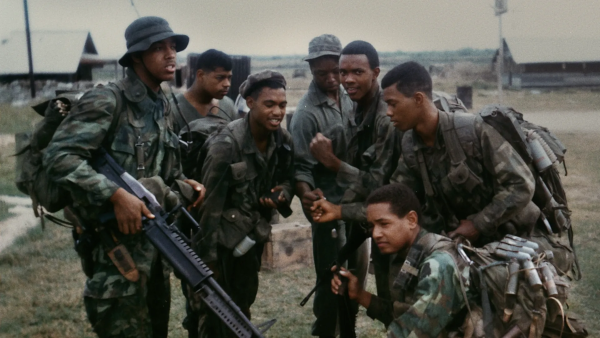
U.S. soldiers who fought in Vietnam were often unfortunately linked by protesters back home to the political and military architects of the disastrous excursion there. For Black soldiers, the disrespect was even more insidious, as the military apparatus itself all but erased them from the narrative, an unsettling takeaway from J.M. Harper’s absorbing documentary, Soul Patrol, based on the 2003 eponymous memoir by Ed Emanuel, one of the men who fought 10,000 miles from home as part of an all-Black special-ops unit.
Harper’s probing but sensitive camera, with vibrant black-and-white cinematography by Logan Triplett, concentrates on Emanuel and several members of a squad called the Soul Patrol: Lawton Mackey, Thad Givens, Emerson Branch, Jesse Lewis, Willie T. Brown, Willie Merkerson, and Norman Reid. At their 50th anniversary reunion, the men passionately remember the era in which they joined the army, when the mood in the country was downbeat, especially following the 1968 assassinations of Martin Luther King Jr. and Robert F. Kennedy a couple of months apart and despite civil rights gains.
Together, the men of Soul Patrol became part of a LRRP, or long-range reconnaissance patrol, for which they rigorously trained for regular forays deep into the Vietnamese jungle, dangerously near enemy lines. It was one of these missions that forced Emanuel to realize that “our team didn’t have a chance to live.” The army had no problems putting this unit in harm’s way, underscoring the still-prevalent racism in the higher ranks. Jesse Lewis states that Black soldiers were literally written out of official accounts of the war, both in the media and in the armed forces. He mentions a front-page article with a photo of only White soldiers as a typical example.
Several Black leaders, from Stokely Carmichael and Bobby Seale to Harry Belafonte and Muhammad Ali, pushed back against this double racism at home and in the rice fields; they saw the irony of Black individuals being sent by their own country to kill young foreign men who had never threatened them, while domestic threats against them were very real. One of the filmmaker’s coups was to bring the men’s wives and partners together to speak frankly and honestly about how they deal with their soldiers’ PTSD and vivid memories, underscoring the immense physical and mental toll the war took on them.
While telling this harrowing account, Harper at times gets unnecessarily manipulative, as if he doesn’t trust his heroic subjects, whose weathered faces tell just as much as their painfully frank accounts. In addition to the voluminous amounts of archival footage from that era—much of it well-chosen—Harper also includes many stylized live-action reenactments of the unit facing mortal danger in the jungles, accompanied by the score by composers Christopher Lyo and Mike Thies. When used sparingly, reenactments can effectively reinforce the intensity of real-life drama for which there are no video or audio records. However, in Harper’s hands, they threaten to obscure the men’s own story, particularly in a too obviously symbolic supermarket sequence where a young actor stands side by side with Emanuel.
Nevertheless, Harper has captured these men’s courageous stories on film. Since some of them have passed away after being interviewed, Soul Patrol will also live on as an invaluable record of firsthand testimonies correcting a whitewashed history.




Leave A Comment