
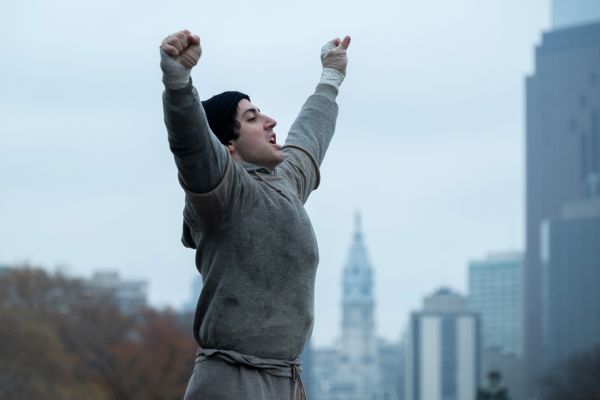
On the eve of its 50th anniversary, Rocky remains the quintessential Hollywood underdog story. Not just its status amongst sports movies or Sylvester Stallone’s iconic performance, but how the film got made perfectly mirrors the long, uncertain journey of facing immeasurable odds and coming out victorious. This historical quality gives I Play Rocky an edge beyond the standard biopic formula, while the struggles behind Rocky’s production become a stellar drama.
Those entering I Play Rocky blind will be stunned by how seamlessly Anthony Ippolito transforms into young Stallone. Ippolito already has experience playing famous 1970s actors on the cusp of their big break—having portrayed Al Pacino in Paramount+’s The Offer—but it’s not just Stallone’s broad shoulders and distinct speech impediment being imitated here. He also captures the soulfulness and quiet vulnerability that made Stallone’s early characters relatable even at their most muscular. Pre-Rocky Stallone is hardly a star. He’s a struggling extra reading for thug parts under the stage name Mike and working odd jobs—such as a ticket taker at a movie theater—to pay his New York rent in the 1970s. When he is kicked out of his grungy rooming house over unpaid rent, an early economic necessity forces him to take on what would become his infamous foray into softcore porn on a film titled The Party at Kitty and Stud’s (later re-released as Italian Stallion).
Stallone isn’t a fool. He knows he doesn’t have a leading man face, though his looks are enough to win over box office cashier Sasha (AnnaSophia Robb)—who would become his first wife—while he also has to endure the snide remarks of his abusive barber dad (Matt Dillon). Recognizing that Hollywood isn’t writing parts with him in mind, Stallone and Sasha eventually relocate to Los Angeles to push forward. There, a customer at his valet job gives him an introduction to producers Robert Chartoff (Toby Kebbell) and Irwin Winkler (P.J. Byrne). However, that initial meeting doesn’t yield any results. Inspiration strikes, though, after Stallone watches the Muhammad Ali and Chuck Wepner fight, and from that 1975 match Rocky is born. Written in three and a half days with Sasha’s help, the script dazzles Chartoff and Winkler, only for Stallone to shock them with one primary demand: He, not some big-name A-lister, plays Rocky Balboa. Nor is he budging from that stance, no matter how much cash studio executive Sandy Maddox (Tracy Letts) insists the producers throw at Sly to negotiate the script out of his hands.
Even with the standoff’s outcome being a foregone conclusion, watching Stallone go the distance ends up being just as thrilling as watching Rocky hold his own against Apollo Creed. It works because I Play Rocky frames its lead in the same mold as his Philadelphia counterpart, a down-on-his-luck longshot who just wants his chance at something big. By prioritizing the man’s inner life and struggles—amongst them the infamous story of Stallone selling his dog Butkus due to financial strife—we see why he won’t be moved by offers that would set anyone else for life. Ippolito not only makes that determination to play Rocky feel authentic, but his performance ends up being as worthy of an Oscar nomination as Stallone’s felt decades ago.
The Rocky franchise has gone through many iterations over the decades, from the over-the-top Cold War–era spectacle of Rocky IV to the contemporary grittiness of Creed. Here, director Peter Farrelly—surprisingly in his element after directing several comedies and the controversial Oscar winner Green Book—magnificently captures the look of a ’70s-era New Hollywood while straddling a line between sophisticated and sincere. The earnestness benefits Sasha’s role as Stallone’s real-world Adrian, with Robb establishing her character as an emotional anchor at home, on set, and even when the goal of playing Rocky feels like a pipe dream. That money offers go up as their economic situation becomes more perilous could have succumbed to old Hollywood clichés, but I Play Rocky instead uses this to make a point about trust in relationships, making for a more complex portrayal of romance.
Where the film loses its footing in the ring comes down to how much of the Rocky production storyline it ends up depicting. That is to say, nearly all of it. To bring the film in on a slashed budget and tight schedule, the producers hire director John G. Avildsen (Jay Duplass). We’re introduced to key figures like Carl Weathers (Stephan James), the origins of its Steadicam cinematography, and even learn the real reason why Philly was selected as a filming location. This makes for some fun moments highlighting the film’s low budget and lack of room for error, but at a certain point you’re left wondering if every scene was necessary. Ultimately, this creates the impression of a screenplay relying too much on the nostalgia of witnessing iconic Rocky moments being created rather than making each one integral to the plot.
Still, it’s impressive that I Play Rocky works beyond just nostalgia. Even if you know the story behind Rocky, the film succeeds as a character study about an underdog putting everything on the line because he believes in himself, even when so many declare otherwise. You’ll cheer for young Stallone’s journey as much as you will Rocky’s, and that is more than worthy of a post-training montage complete with the victory pose.








Leave A Comment