Are you in the mood for a three-hour documentary partly surveilling Elizabeth Holmes’s domestic and private life with her family in the weeks before she goes to prison, partly disrupting form and storytelling in an experimental manner, and all under the active, participatory gaze of Nathan Fielder, the eccentric Canadian actor and comedian with a niche following?
Hardly any of those aforementioned elements suggested, at first, that You Can See Everything would be anything more than a film likely to appeal to specialized audiences. Now, however, it has earned strong box-office numbers and maybe a historic first-ever Best Picture nomination for a nonfiction film. These details are inescapable when reviewing the film at this point, as opposed to having done so before its release, but they are also compelling factors to consider in this joint effort by Lance Oppenheim and Fielder.
Can you believe the hype? Short answer: Yes, but let’s not fully conform to unquestioned praise. Here we have a film that announces it begins 34 days before Holmes starts serving her 11-year prison sentence in a well-known case of investor fraud. One of the first bold decisions right from the start: We won’t hear much of the already available facts or context about Holmes and her crimes as the founder of Theranos, the company behind the failed promise of a device that would revolutionize blood testing. If you go in too blind (and that may well be the case for audiences overseas), good luck with that: How useful is it to see everything if you know nothing?
The filmmakers were invited by Holmes and her husband, Billy Evans, into their rented beach house in Del Mar, California, which also raises some important ethical questions: How much ownership and control over the narrative will Holmes and Evans have? Will they profit from it? Will the fraud victims receive proper consideration and counterbalance? The answers: first, as much as they can manage, with or without success; second, even if they don’t profit directly, it remains uncertain how they might capitalize on the fame and exposure that will come with it; third, are you kidding? No way! If you don’t know anything about Fielder’s work (TV shows like Nathan for You and The Rehearsal), and you don’t need to, let’s just say he has a particular way of bending reality and fiction toward higher purposes, one that also involves the strangest brand of comedy you could imagine, while exposing the fakery of real people and their performative ways.
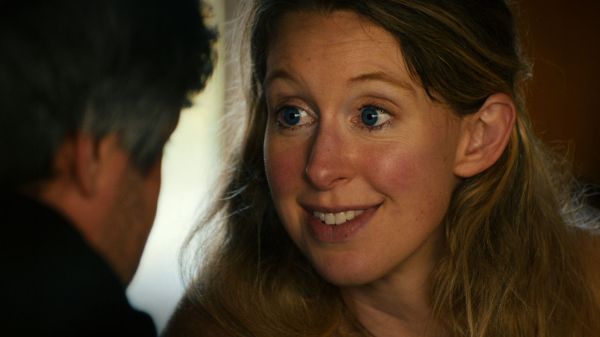
There are some expected tropes: long interviews, domestic bliss and sadness from a couple who are also parents, aware that they are experiencing their last days together as a family until God knows when, and the fulfillment of the promise of unrestricted access. Fielder questions Holmes about her own concept of truth, revealing her as deeply evasive: She’s fully convinced that she has never lied in her life. It’s all about semantics. She also doesn’t fully understand why she would go to prison, and still believes in the viability of her Theranos device. Meanwhile, Fielder asks Evans whether he is ever afraid that she’s scamming him, given that he comes from a wealthy family. He swears that his life with Holmes will amount to “monuments of love.” He’s also unafraid to shower in front of the cameras, giving viewers full-frontal nudity (guaranteeing that, if nothing else, we can indeed claim to have seen everything).
Some bits are pure gold, such as Fielder showing Holmes an Abbott and Costello routine of which she cannot understand the humor, or getting her to watch Amanda Seyfried play her in the miniseries The Dropout. If you suspect Fielder is psychologically torturing her in some way, you might be right. Both Holmes and Evans produce an uncanny effect. They seem to exist with an awareness of being watched and discussed, shaping their views, behavior, words, and actions accordingly. They remain unreadable on a deeper level, for the most part, until Holmes can no longer be a subject in front of the camera because of her sentence.
Fielder is then left with Evans as an unreliable source for what Holmes thinks and says. He holds power of attorney, allowing him to post from his wife’s account or create an AI model of Holmes. Is it unavoidable to feel sorry for her? Is this another story about a woman whose agency has been taken away by the men in her life, regardless of her own faults? Sure, the lesson seems almost too ready-made and perfect. But there are other possibilities that are excavated once we see that she has the right instincts about when and why to leave the room.
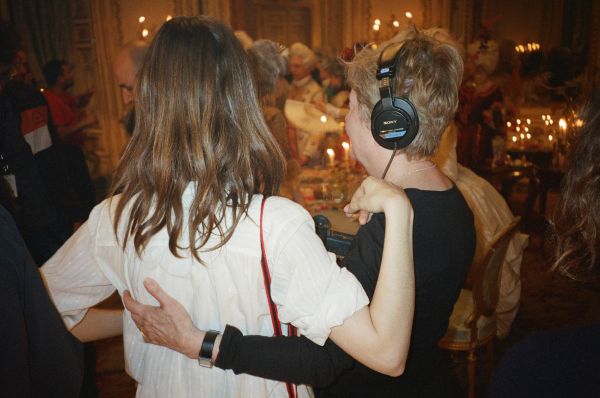
The second half demands new ways to move beyond what, up to that point, can be described—both derogatorily and complimentarily—as an elevated reality show. Fielder considers it necessary to include reenactments of events before and after the days spent with Holmes and Evans, including the negotiations that made the documentary possible with A24 executives. For this, he enlists a special actress, whose inclusion ultimately becomes one of the film’s riskiest but also most brilliant decisions. This creates the kind of friction that cannot be scripted or predicted.
On the other side of this distorted mirror, You Can See Everything reveals itself as a fundamental post-truth work, pushing the limits and uncharted possibilities of nonfiction cinema, perhaps the most underrated genre and format of visual storytelling. It also captures the zeitgeist in a way that other successful or over-discussed works of recent years can hardly dream of. Maybe the answers about the future of cinema are somehow contained here, whether we like them or not, while reminding us that audiences’ not-always-predictable appetites can still produce rare outcomes. Fielder and Oppenheim have dropped a philosophical bomb that could eventually affect the tacit integrity of nonfiction works, perhaps because it was a matter of when, rather than if. Do we allow ourselves to question the hunger to vampirize reality and hijack fiction in pursuit of sinister mixtures of entertainment? We haven’t seen enough of it yet. And that alone is reason to feel both scared and curious.







Leave A Comment