
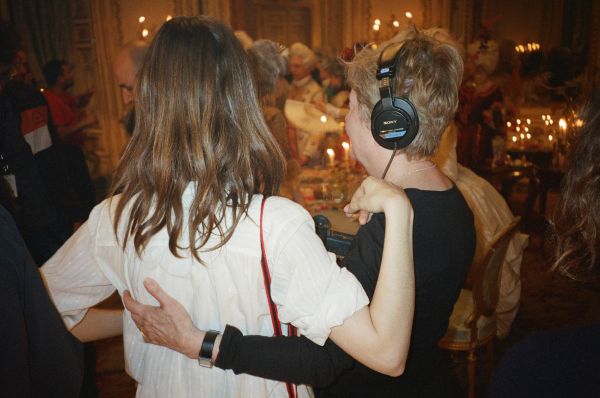
Eleanor Coppola’s Making Marie Antoinette is a masterclass in observation, capturing her daughter Sofia Coppola at work on the set of her lavish 2006 historical drama.
For Marie Antoinette, Sofia had 57 shooting days and an unprecedented level of access to the Palace of Versailles. Eleanor shadowed the set, recording roughly 80 hours of digital footage. In 2020, during the “lockdown bubble,” she began going through this archive. After she passed away in 2024, Sofia finished the project with editor Aaron Matthews to fulfill her mother’s wish.
The documentary features a voice-over by Diane Lane, the lead in Eleanor’s Paris Can Wait (2016), her narrative feature debut at age 80. Lane reads from Eleanor’s personal journals, adding a motherly element to the footage. In these musings, Eleanor says, “I want to be as invisible as possible on my sets,” and the moments we glimpse her, with camera in hand, Eleanor is wearing nondescript black clothing. Her maternal instincts break through, though. When Sofia falls ill with bronchitis during the stressful shoot, Eleanor, unbeknownst to her daughter, breaks with her fly-on-the-wall stance and requests that a doctor come to the set.
The work showcases the bold choices that turned the 2006 film into a cult favorite and style touchstone. It particularly highlights the crafts, such as 72 custom gowns for Kirsten Dunst, in the eponymous role, by costume designer Milena Canonero. Emphasizing the luxurious, fanciful aesthetics are dazzling food spreads, with oddities such as green gelatin molds, and abundant real flowers, including lovely unopened pink peonies.
Sofia explains her anachronistic pop music choices, noting how she was inspired by bands like New Order, Bow Wow Wow, and Adam and the Ants from the New Romantic movement of the 1980s. The soundtrack also features her then-boyfriend and now-husband, Thomas Mars from the French indie rock band Phoenix. With a wink, “I Want Candy” plays as a backdrop as the young queen indulges in colorful fabrics and shoes. Sofia wanted her film to have an irreverent teenage quality, because Marie Antoinette was very young at the time.
She cast the film with spirited young people who shine between takes, such as Jason Schwartzman as Louis XVI, playing modern tunes on a harpsichord and cracking jokes, while Dunst sips canned wine, both in royal costume.
Eleanor’s camera captures the scale of the production, showing film equipment stored inside Marie Antoinette’s historic bedroom and extras having their makeup applied in long palace corridors. In one overhead shot, Eleanor records a processional followed by the crew of cinematographer Lance Acord.
The voice-over reveals a mix of resentment that Eleanor is not doing her own thing alongside her exhilaration at watching Sofia’s work, calling her daughter’s images intoxicating. She reflects on the film industry being historically dominated by men, remarking that Sofia’s generation is fortunate to have a marriage, children, and a fulfilling career all at once. Yet, balancing support for her family with her own unfulfilled ambitions creates a wistful tension. Eleanor asks, “At my age, shouldn’t I be engaged in my own creative process, not just observing the work of my talented family?” (She had previously shot footage for 1991’s Hearts of Darkness: A Filmmaker’s Apocalypse that won her and co-directors Fax Bahr and George Hickenlooper an Emmy for its behind-the-scenes look at her husband Francis Ford Coppola’s Apocalypse Now.)
The mother-daughter relationship has its boundaries, however. At one point, a tired Sofia tells the camera she doesn’t want to do what feels like a press junket with her mom, when Eleanor puts the camera directly in her face. When Eleanor comments that Sofia’s films have consistently been about lonely, privileged girls, Sofia dismisses the idea.
Along with her mother, Sofia is surrounded by a collaborative family network. Her father, the legendary director, offers filmmaking advice. Her brother, Roman Coppola, works as a second-unit director and calls his sister soft-spoken and reserved, a contrast to typical, pushy male directors. Her niece, Gia, appears as an actress seen getting a wig change, and co-star Schwartzman is her cousin.
Toward the end of her shoot, Sofia reflects on the massive undertaking, noting that directing big, period movies is not for her. “I enjoyed it, but I’m never doing this again,” Sofia says, regarding her exhaustion. The film closes with fireworks celebrating the wrap of Marie Antoinette. Eleanor’s video diary shows that time has softened some of the critical disapproval of the 2006 film’s decadence, leaving behind a tribute to a mother’s quiet devotion and a daughter’s vibrant art.
Making Marie Antoinette serves as a salute to the original film, as another look at its lush, pastel atmosphere, and hectic but jubilant set. It played in the Spotlight section of the New York Film Festival and Mubi will release it theatrically on October 23.



Leave A Comment