
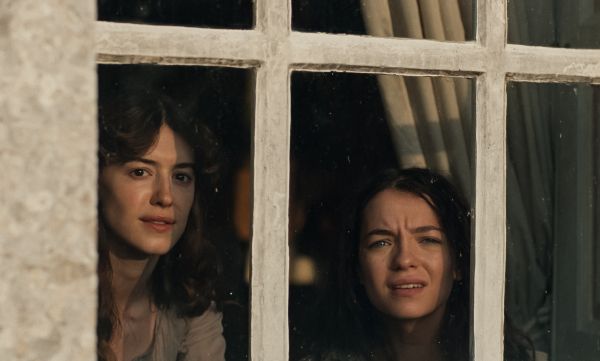
This October 30 marks the 215th anniversary of the publication of Jane Austen’s debut novel, Sense and Sensibility. Over the years, this romance and social satire about two sisters with divergent attitudes to life has been adapted multiple times for television and the big screen, most notably in 1995 with Ang Lee’s Oscar-winning version starring Emma Thompson and Kate Winslet. Given the long shadow that now-iconic film has thrown over subsequent adaptations, including a 2024 Hallmark Channel production, kudos to Blue Jean director Georgia Oakley and screenwriter Diana Reid for attempting a fresh interpretation that differs in style and tone from Lee’s polished gem. Unfortunately, their more sober, naturalistic take comes at the expense of the novel and its author’s intentions.
The film opens quietly with romantic Marianne Dashwood (Esmé Creed-Miles), her long hair loose, lying in a sunny, grassy meadow, reveling in the beauty of nature, before she leaps up and runs through the woods to catch the post and news of her father’s will. Arriving home to Norland Park, she, her sisters Elinor (Daisy Edgar-Jones) and Margaret (Bodhi Rae Breathnach), and their mother (an underutilized Caitríona Balfe) learn that they have been left with only 500 pounds a year and that the estate will go to their half-brother, John (Tom Brooke).
The only consolation is a visit from John’s brother-in-law, Edward Ferrars (a muted George MacKay), to whom Elinor is immediately attracted. But, of course, being the practical, reserved sister, she keeps her feelings to herself. With the assistance of a distant cousin, Mrs. Jennings (a scene-stealing Fiona Shaw), the Dashwoods find a humble cottage to rent in remote Devon. There Elinor nurses her secret heartbreak and, to the chagrin of an admiring Colonel Brandon (a stolid, bearded Herbert Nordrum), Marianne develops an infatuation with the roguish Willoughby (Frank Dillane) when he rescues her on a beach after she twists her ankle.
Although the screenwriter makes some plot changes that may raise the hackles of die-hard Janeites (such as staging a duel that is only mentioned as prior backstory in the novel), the storyline basically sticks to Austen’s work. More questionable are the choices the director made to make her film more edgy and up-to-date. Why was a Norwegian actor cast to fill the enormous shoes of the very English Alan Rickman as Colonel Brandon? Why was the musician and actor Eliot Sumner (offspring of Sting and Trudie Styler) cast as Mr. Palmer? It felt more like distracting celebrity stunt casting than an instinctive fit.
There are the odd ballroom scenes (choreographed by Holly Blakey but shot beautifully by director of photography Arnaud Potier) that feature traditional courtly dances combined with contemporary movements (exaggerated sweeping arms, lifts, and backward bends) that feel more Broadway than Georgian England.
And then there is the hair: long, flowing hair that was acceptable in a childlike Margaret but not suitable in the late 1790s and early 1800s for young women in society on the marriage market. It’s understandable that Oakley was going for a naturalistic feeling and raw emotion in her adaptation, and the viewer could accept the high-spirited Marianne going for that wild, windswept look, but it’s not believable in the buttoned-down Elinor, who keeps her emotions tightly under wraps. Indeed, partly because of the messy hair, it’s hard to distinguish between the sisters, despite their differing dispositions.
And that is a major problem. Austen’s novel emphasizes that both sense (reason) and sensibility (feeling) in balance are essential in the pursuit of happiness. But the director makes Marianne’s mistake, emphasizing pure romance and feeling over wit, humor, and good sense. With its muted palette and flat, charmless acting, the result is a dull slog through Romanceland. Perhaps Oakley should have chosen a Thomas Hardy novel instead.








Leave A Comment