
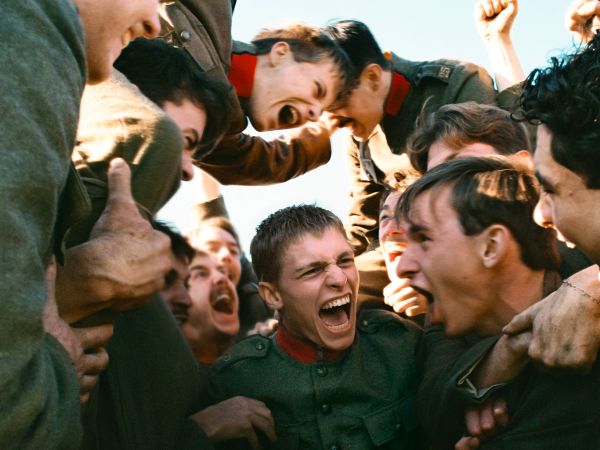
In his third film, Belgian director Lukas Dhont prints his own stamp on the brothers-in-arms genre, giving it a touch of the erotic while turning it into an erstwhile musical. At the same time, his World War I drama has more grit and muck than the recent 1917, in which the trenches look pristine by comparison.
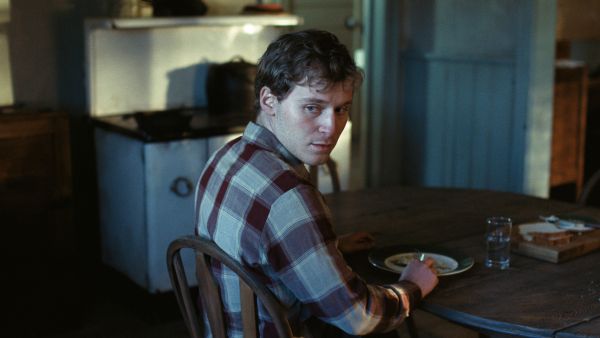
A sandy-blonde, lanky farmer boy, Pierre (Emmanuel Macchia), nicknamed “Tall Rookie,” at first appears as just another face in a crowded train compartment on the way to the Western Front. A silent, wide-eyed observer, he follows along, picking up cues from his comrades, boisterously singing along in French to “Pack Up Your Troubles in Your Old Kit-Bag, and Smile, Smile, Smile” or following orders not to think as he lifts and carries corpses away after a battle. The 18-year-old also reluctantly engages in abhorrent behavior, goaded by his peers: pissing into the soup prepared for German prisoners of war. This war film has at least one thing in common with another movie coming out this year, Reed Van Dyk’s poignant Atonement, in which an Iraq War veteran, in describing his wartime actions, states the military has a moral code of its own. It, like Coward, screened at the Toronto International Film Festival.
Likewise, in Coward, the uniformity in the soldiers’ actions on an unnamed French battlefield (presumably the Somme) reinforces the diminution of the individual. Anyone who stands out as an outsider or without a backbone faces ostracism, or worse. It’s all for one and one for all.
Pierre joins a group of recent, emotionally constrained cinematic protagonists, perhaps to the point of wearing down viewers’ patience: Will Poulter in Union County and Joel Edgerton in Train Dreams. Another alias for Pierre could be “Big Lug”; it is at times hard to read what he thinks. (He also goes by the equally appropriate “Quiet Mouse.”) Yet the reticent rustic throws caution to the wind and becomes a little bit more expressive. Enter Francis (Valentin Campagne), a charismatic leader of a theatrical troupe of recruits lifting up the spirits of the troops. Encouraged by the gregarious Francis, Pierre joins the backstage crew as a backdrop painter.
Despite being called “the Band of Rejects,” most of the performers seem physically capable of serving, even if a few are injured and presumably a few might be conscientious objectors. Of slight build, but boldly exuding big character energy, Francis, a tailor, easily takes the spotlight, notably when in drag as a comely chanteuse. (In an over-the-top moment, his singing “Plaisir d’amour” brings tears to an audience.)
Nevertheless, this is one of the best films at the festival to mix many tones. Dhont skillfully builds tension—when Pierre joins two other men to repair the barbed wire at night under the threat of enemy fire—and alternates the battlefield suspense with lighthearted scenes and musical numbers while fluidly laying down the groundwork for an emerging romance between Pierre and Francis amidst the carnage.
The strength of the screenplay, co-written by Dhont and Angelo Tijssens, lies in the steady transformation of Pierre, who morphs from a cautious realist to a dreamer. Indeed, if this were a jukebox musical, one suitable selection would be “Somewhere” from West Side Story. Segregated from the rest of society and able to consummate their relationship privately, Pierre and Francis are free from censure or prison. They thrive in a cocoon of their own making. As Francis says, “In the real world, we couldn’t do this.” By that, he means engaging in a hot and heavy relationship. Yet, as the song goes, Pierre believes, “There’s a place for us.”
In a short time, Dhont (Close and Girl) has risen as a remarkable and lucid storyteller, the proof of which lies in two standout sequences. One occurs as the “rejects” perform for a hospital ward of wounded—physically and psychologically—young men. (No spoilers here.) That said, there are moments of overstatement, mainly the plaintive stares shared between Pierre and Francis. As a response to their longing looks, you wonder why no one shouted, “Get a room already.”
Still, the director makes economical use of the 125-minute running time. After the TIFF screening, I heard rumblings that the coda felt tacked-on and was unnecessary, rather than leaving viewers with a more ambiguous ending. Yet, this section contains a whopper of a violent outburst. Again, the less said, the better.
Coward will be released in the United States via Mubi on December 25.




Leave A Comment