In its 64th edition, the New York Film Festival rises to the occasion, providing a space where both Hollywood talent and international filmmakers can come together on equal footing.
It is, therefore, worth highlighting three films that, to a great extent, fall under the category of “festival films”—works that have little to no commercial prospects outside of their dedicated audiences, but that in one way or another are difficult to shake from our imagination. Such a haunting remnant is a good indication of the power wielded by directors committed to their vision to the very end, led here by three veteran South American filmmakers: Lisandro Alonso with Double Freedom, Carlos Reygadas with Heil, Jupiter!, and Mariano Llinás with The Life of Jorge Luis Borges.
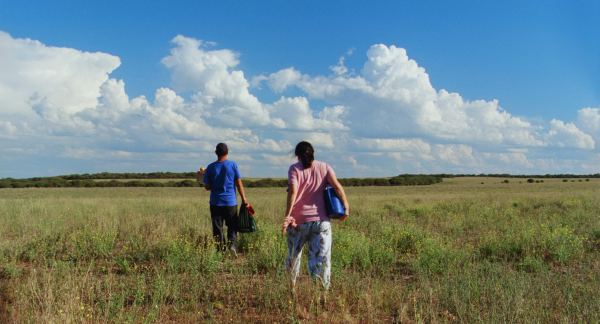
The concept of slow cinema is one of those cinephile and academic fixations that thrive at events like NYFF. In this regard, Argentine director Lisandro Alonso has emerged as a herald. Double Freedom arrives with a curious familiarity, serving as the sequel to his acclaimed directorial debut, La Libertad (2001). He revisits the same man from that documentary, reevaluating his almost unchanged circumstances 25 years later. Thus, this second part returns to woodcutter Misael Saavedra, whose precarious living conditions still serve as a sample of Argentina’s rural workers, but also as a distinct symbol of a life almost free from many contemporary concerns.
Once again, Double Freedom begins with a sequence long enough of Misael cutting trees and wood that you begin to wonder whether this is actually an exercise in remaking the first film. However, this time Misael is not the only focus of interest; the freedom he takes for granted is confronted by circumstances beyond his control. The state-funded care facility where his disabled sister Catalina (Catalina Saavedra) lived can no longer accommodate her because of budget cuts, so she must live with Misael in his not particularly spacious shack with a single bed. He must also learn about her schedules and the medications she needs, which will still be provided.
While this sequel won’t move any faster, it adds an extra dynamism, with Misael’s peace interrupted by a conflict that does not shy away from social commentary on Javier Milei’s Argentina and his libertarian measures. Alonso once again contemplates those who have already resigned themselves to having little, but who must now give up the particular tranquility of their inner worlds as well.

Presented as a world premiere at the festival, Heil, Jupiter!, meanwhile, is a much harder-to-digest narrative, one that successfully captures what Herzog once called, paraphrased here, those necessary, impossible images, the ones that should always be cinema’s guiding light to prevent its obsolescence. Carlos Reygadas has created what will undoubtedly be the most divisive film of his career, as well as the most shocking. It is a work worth debating either as a vital and repellent visual manifesto that reflects our present ailments (indifference toward other people’s suffering, the rise of authoritarian governments) or as a pretentious obscenity of audiovisual terrorism.
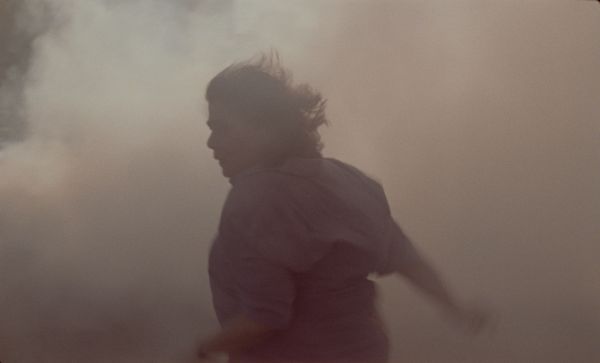
Heil, Jupiter! is an absolute nightmare, so my admiration for it cannot help but celebrate it with warnings for the unwary. Set in an indeterminate time and place, and spoken mostly in a language specifically invented for the film, it depicts what could be described as a not-so-distant future or an alternate. In this universe, destinies are revealed to be controlled and dictated by invisible voices (extraterrestrials? artificial intelligence?), public executions are staged as almost medieval ritual spectacles, and police raids interfere with the privacy and safety of ordinary people marked for arbitrary reasons. (It is impossible not to think of the situation in the United States with ICE). It ultimately leads to a lengthy trial shown through security cameras, with panels multiplying across the screen in a kaleidoscopic fashion, recalling the circuses that so often define the administration of justice. Take all that in addition to various cruelties that are sometimes chilling, precisely because they are merely alluded to rather than shown.
The introduction still retains expected Reygadasian tropes: a sort of progressive oceanic genesis (it also evokes the creation of the world as an atomic explosion), in which four young people (two men, two women) undress, plunge into the water, and explore each other’s bodies in an Edenic state. (The pairings are not strictly heterosexual.) From there, all that remains is to give way to the world that will corrupt and destroy them, as the camera makes its way into the anus of one of the men. We can assume that it is from this vulgar and mocking gesture that the movie exists thereafter.
Reygadas constructs an ugly and hypnotic film that has led the director to exchange his usual lyricism—devoted to the silencing beauty of nature that links him to Terrence Malick in films such as Silent Light—for more blunt effects and less elevated experiments. When the year is over, I suspect I will still be thinking about this particular film over many other, more acclaimed and accessible works. Perhaps not necessarily because it is better, but because it feels animated by an ancestral rage and contains a spirit of novelty and freedom, proving that not everything has already been done and said in cinema. More horrifying than any horror movie released this year and more visionary than many sci-fi movies yet to come, Heil, Jupiter! is a time-traveling testimony from the end of times.
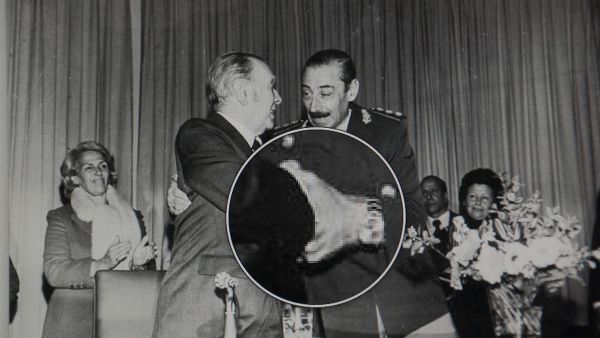
As a kinder, exuberantly fun piece of counter-programming—even if it’s a five-and-a-half-hour documentary punctuated by two intermissions—The Life of Jorge Luis Borges lives up to the vast and influential universe of that titan of Argentine literature, one who in turn achieved a level of universality that transcends languages and origins. Nevertheless, it required an Argentine director deeply connected to and in love with his homeland to understand Borges in all his specificity, and thus reexamine his life and work from different angles, like movements in an ambitious and confident symphony.
For filmmaker Mariano Llinás, long running times are nothing new. (His previous film, La Flor, a towering achievement of South American cinema, ran for 14 hours.) The director’s devices have frequently been described as Borges-indebted, and here the film begins with a pile of books placed on a table until it overflows—some by Borges and others by national and international authors from different periods, surely evoking the Borgesian idea of the Library of Babel. Llinás is not content to remain behind the camera. In another Borgesian device, he becomes both narrator and character.
Llinás warns that this film exists because it was commissioned by the owners of a particular private collection of Borges memorabilia, and that his life will be explored only through objects and places associated with that collection. Hours later, we absorb Borges’s passage through this world from Geneva to Texas, and even Iceland, while drafts, photographs, letters, and books open and close new worlds containing enemies, disappointed loves, and his questionable political positions, which he privately regretted perhaps too late. Every so often, Llinás becomes distracted by subjects that are not strictly about Borges, allowing us to watch both the documentary and its own making-of—a fascinating experience in itself where both the result and the creative act are documented.
In short, The Life of Jorge Luis Borges is an extraordinary odyssey of revelations and deceptions, not unlike many of Borges’s short stories. A writer’s life—that of one of the few who arguably changed and advanced literature on a formal level—unravels in a labyrinth of forking paths guided and refined by quotations and detective games. What begins as a methodical Borgesian concoction of variations and discoveries merges with what can already be claimed as mischievously Llinasian. So many Borgeses lived within one Borges; Llinás doesn’t pretend to capture them all, but traces a route that also brilliantly allows for the digressions “where life enters.”






Leave A Comment