
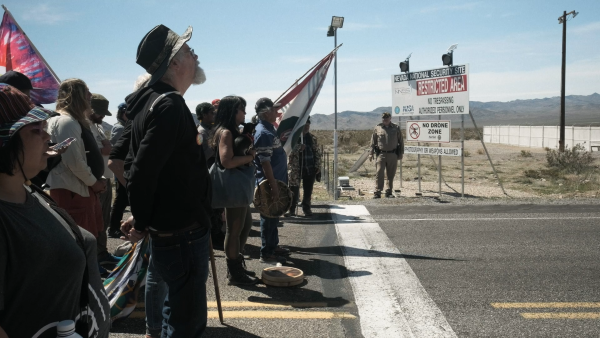
Part environmental/social justice documentary, part real-life X-Files episode, and part road trip from hell, To Use a Mountain makes for informative, engaging, disquieting viewing. Filmmaker Casey Carter immerses you in the federal government’s search for a place to dump radioactive waste, using nothing but government reports and footage of the locales and residents potentially affected by the proposal—no talking heads or experts here. While the effect can be somewhat disorienting and confusing at first, eventually the momentum and logic of what occurs take hold, and you are swept along in a cold-blooded caravan of calculated cruelty—but also inspired by story after story of popular opposition.
The saga begins in 1982, when the Nuclear Waste Policy Act is signed by President Ronald Reagan, and the Department of Energy (DOE) is tasked with finding somewhere in America to create what they call a “repository” for nuclear waste—90,000 tons of it, which will remain hazardous for 10,000 years. The DOE proposes several locations, from Mississippi and Louisiana, through Texas, to Washington State and Nevada, and produces comprehensive reports on the pros and cons of each site. The documentary then takes you on a tour of all the different sites, the communities that will be impacted by the repository, and their resistance.
To Use a Mountain is concerned with raising awareness about the environmental issue, but equally with its artistic form—indeed the two merge superbly well. The music—ambient, atmospheric, with an emphasis on the eerie and foreboding—accentuates the danger looming ahead for each of the communities targeted for the radioactive dumping ground. Despite the grim subject matter, the film conjures an almost Zen-like quality, between the music and the repetition of the government reports flashed on screen in stark black and white, with detailed maps and key excerpts highlighted, as the sound design builds the feeling of dread.
We meet the members of these communities, including descendants of enslaved people in Mississippi, who have lived on their land for well over 100 years, Native Americans of the Yakama Nation in Washington State, and the Shoshone in Nevada. To these populations, government-sanctioned oppression is not some abstract concept; rather, it is an ongoing, life-or-death fact. These communities have never had very secure rights—every right they’ve gained has been hard-won and tenuous. It’s no accident that the government proposed to dump its nuclear waste near these underprivileged areas.
The Yakama Nation in Washington State was an early front-runner to become the repository, since it was near the Hanford site where the plutonium for the “Fat Man” nuclear bomb, dropped on Nagasaki, Japan, was first manufactured. However, the government report states that the nuclear waste would impact the nearby Columbia River. The Yakama Nation relies on the plentiful salmon in that river, and has for countless generations, so poisoning that river would be poisoning a food source that is integral to who they are.
One of the standouts here is Shoshone activist Ian Zabarte, who has been fighting for years to protect his people’s land against nuclear waste. His people live near the site that was finally settled on as the “winning” site: Yucca Mountain. Ian is full of useful information about the history of the U.S. government’s relations with the Shoshone, and he calls the proposed repository on Yucca Mountain “the most complicated and lengthy legal proceeding ever contemplated.” Indeed, the relevant law he recites goes back to the 1863 treaty signed between the Shoshone and the United States, which the Yucca Mountain repository would violate. Zabarte says that if the government wants to do this, they need to renegotiate the treaty, rather than just imposing their will and disregarding the rights of the Shoshone.
Besides the individual activists, there is also plenty of footage of the protests that occurred throughout the 1980s at all of the proposed sites. There was a vigorous activist culture throughout that decade, and they were successful in getting the government out of their lands.
An inspiring look at a hard-to-believe true story, To Use a Mountain is a timely reminder that people power is a force to be reckoned with.







Leave A Comment