
Robb Moss’s latest is a quietly fascinating continuation of his 1982 documentary short “Riverdogs” and 2003’s feature documentary The Same River Twice, chronicling five of his bohemian friends: Jeff Golden, Cathy Shaw, Danny Silver, Jim Tichenor, and Barry Wasserman. They were a tightly knit group of Colorado River guides in their 20s in 1978, when “Riverdogs” was shot, spending most of their sun-drenched days in the nude. In the 2003 film, shot around the late 1990s, they had somewhat disbanded. Jeff and Cathy married each other, with Cathy becoming the mayor of Ashland, Oregon. Barry married, had two kids, and became a mayor as well—of Placerville, California—though he lost his reelection bid while facing a brief bout with prostate cancer. Danny briefly dated Jim, but later became a free-spirited Zumba instructor (classes she still teaches today) and a mother. Because the film weaves in and out of footage from both “Riverdogs” and The Same River Twice, establishing a haunting, at times adrift quality, one doesn’t really have to watch the previous entries, though there is a cumulative power to seeing them together.
Moss’s direction and Jeff Malmberg’s editing are seamless and relentlessly effective throughout. Sometimes folk songs, dialogue, and sounds of the river from different eras play over scenes in the present, and vice versa. Aging is perhaps difficult for anyone to reckon with, but one really feels the weight of it here, especially when watching how carefree this group was in their youth compared to the inward, curmudgeonly resignation some of them now display. There’s even a more knowing, ironic view of being a subject before a camera: “I’m getting familiar with all your cinematic gimmicks,” Barry tells Moss while being filmed in the car, driving to his job at a health clinic he’s soon retiring from.
Jeff and Cathy, whose marital issues were delved into in The Same River Twice—with Jeff admitting, almost bragging, that he was a high-profile “player” (a clip that resurfaces in an attack ad during his state senate run)—are divorced, with Jeff recently marrying a younger woman. However, he and Cathy are decidedly much more amicable now—close, but apart—living across the street from each other. She is even running Jeff’s political campaign.
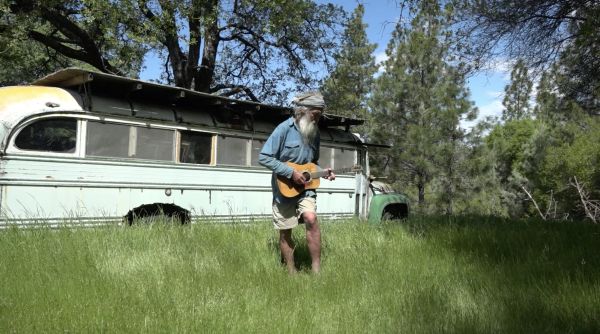
It’s not always specified where everyone is living, but most of them continue to dwell in suburban areas out West, living seemingly financially comfortable lives. Jim, with his long beard and missing teeth, is the only one who remains out in the wilderness. An unfinished house, newly under construction at the end of The Same River Twice, has been long abandoned in the woods. Nearby, he lives in a camper, the same one captured in the previous documentary, which he still calls his “hovel”—full of papers and books (such as his touchstone volume of Noam Chomsky).
The river, too, has changed. So vibrant, turquoise, rushing, and wild in the original film, it is now placid, brown, and far shallower. Climate change, and the current unease of our time, hang over the film—a future that once seemed sunshiny, bright, and colorful, with all the time in the world, now feels more finite, gray, and foreboding. At one point, Barry notes that it feels like we’re in a post-apocalyptic movie as he drives past bare, blackened trees from a recent wildfire.
In that respect, the film carries a different feeling than its predecessors, more melancholic, contemplative, and quiet (partly because the noisy young children of The Same River Twice are now grown). Moss’s sensitive directing offers revealing portraits while also eschewing any judgment or criticism. The years on the river with this group really stick in the mind afterward, spurring one to consider the past and present of one’s own life path.




Leave A Comment