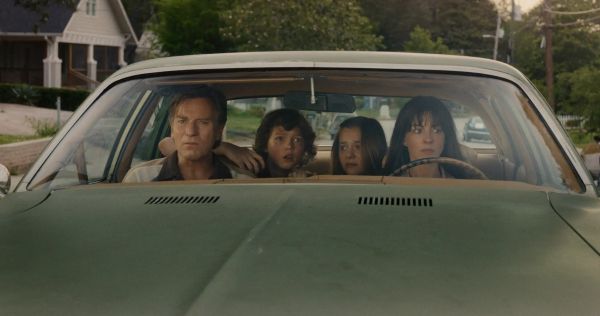
Even before dinosaurs show up, not all is well with the Platt household. A family of four living in ideal 1980s American suburbia, their bonding moments and smiles at a neighborhood block party belie a series of unresolved tensions. Denise (Anne Hathaway) and Greg (Ewan McGregor) are considering a divorce, the former writing a secret novel to vent her marital frustrations and the latter struggling with a drinking problem and extra pizza delivery shifts. Their daughter, Audrey (Maisy Stella), cannot afford to go to her dream college, while their son, Brian (Christian Convery), is stuck in a rebellious phase and crushing on the new girl in town. This Amblin-inspired setup ensures that, once things get out of control (and time), The End of Oak Street gives you genuine reason to care about who survives the upcoming prehistoric mayhem.
It is a testament to director David Robert Mitchell, of It Follows fame, that all these elements blend together so nicely. Having taken an eight-year absence since Under the Silver Lake, Mitchell is back with a simple premise drawing from obvious cinematic references that contrasts everyday settings with schlocky sci-fi horror invaders. Primitive War aside, Hollywood has long struggled to make an entertaining dinosaur movie that is not stuck in Jurassic Park’s shadow, a problem that has bedeviled even the “Jurassic” franchise for decades. Despite some occasional stumbles, The End of Oak Street is that entertaining movie.
The aforementioned Platt family drama takes center stage for most of the first act, with occasional broadcasts and anomalies hinting at something amiss. News reports warn of solar flares in space, mysterious bright lights appear at night, and, after finding a strange plant in her neighbor’s yard, Denise is told its closest equivalent has been extinct for millions of years. Then, one evening, a light engulfs the entire neighborhood, dropping the Platts and their dog Starbuck into the middle of the Cretaceous period. All streets are blocked off by thick vegetation, swamps, or massive cliffs, leaving everyone at the mercy of a carnivorous welcome wagon. Staying alive is top of mind for this family, even if the chances of returning home feel next to impossible.
As characters, the Platts represent a great balance of “just smart enough to survive” and “hopelessly out of their depth.” These are not elite soldiers or people hiding a secret John Wick past, but a normal nuclear family grappling with a terrifying predicament, and you feel that every time they cross paths with a dinosaur. Mitchell also takes great pains to hide the dinosaurs for as long as possible, with characters remaining unaware of their true situation until that situation chases them back to the house. They are constantly vulnerable, and that tension drives much of the horror to great effect, balancing dual stories of survival and reconciliation.
While Mitchell eschews the sense of wonder that balanced out Jurassic Park’s scares, these dinosaurs are still impressively constructed, not to mention more aligned with scientific accuracy by displaying ruffled feather-like skin in place of the old scaly forms. For the most part, the creatures invading Oak Street are predators or wild animals (from a violent T-rex to a very long snake), with Michael Gioulakis’s cinematography emphasizing this size difference whenever the dinosaurs are running through homes, cars, and picket fences—much to the detriment of local residents, however limited their roles. An obnoxious neighbor (P.J. Byrne) and an older boy with a vendetta against Brian are introduced early on, but the focus on the Platts rather than the entire neighborhood means they are mostly left on the sidelines.
This film is not interested in dwelling upon the hows and whys behind a suburban neighborhood traveling back in time, save for one attempt at sci-fi techno-speculation. There are also some space-time paradox moments in the climax that, despite wrapping things up, do not sync up as well with the rest of the movie’s internal logic. Ultimately, The End of Oak Street is a pulp concept mixed with ‘80s-inspired storytelling and gory, pulse-pounding execution, and it never loses sight of the fun that comes from such absurdity. That sentiment is best exemplified when two characters come across what I can only describe as the most WTF scene of 2026, if not the past decade of sci-fi cinema. It is shocking, bizarre, and darkly amusing given everything happening around them, but it ends up taking on a twisted sentimentality down the line.
The End of Oak Street delivers exactly what its trailers promised, including Denise distracting a T-rex with a shotgun. That it throws in some extra Spielbergian and Twilight Zone flair makes this an unexpected summer delight for anyone yearning to see killer dinosaurs in theaters again.
Leave A Comment