
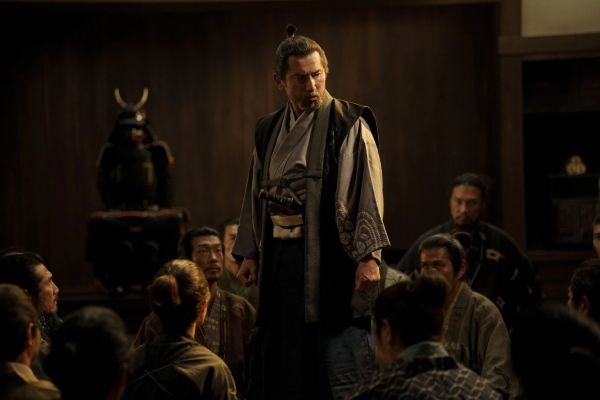
The traditional account goes like this: Lord Murashige Araki was a 16th-century feudal lord elevated to that rank under the command of Oda Nobunaga, the famed “Great Unifier” of Japan. In that position, and as one of Nobunaga’s allies, Murashige presided over an impregnable castle. Years later, he was accused of siding with Nobunaga’s enemy, the Mōri clan, and his domain endured a yearlong siege before ultimately falling. Yet after his prolonged resistance, Murashige not only survived the siege and escaped the honorable death expected of him, but went on to spend the rest of his life as a tea master.
This saga, centered on a man who has long stood as a symbol of betrayal and cowardice, has been reimagined through Honobu Yonezawa’s 2021 novel The Samurai and the Prisoner and its subsequent film adaptation by Kiyoshi Kurosawa. The result is far more than an exercise in historical revisionism. Instead, it functions as a philosophical and spiritual meditation on how noble and honorable the samurai code truly is when it demands so much bloodshed and violence. With a screenplay written by the director himself, Kurosawa finally ventures into the samurai genre for the first time, though in a far less conventional fashion than its impeccable production design and lavish craftsmanship initially suggest.
As he fortifies himself inside Arioka Castle against Oda’s advancing forces, Murashige (Masahiro Motoki) rules over a kingdom that is collapsing morally and spiritually from within even as its physical downfall is being orchestrated outside its walls. He has grown weary of endless executions carried out in the name of supposedly honorable codes, though none of the generals and retainers under his command share his exhaustion. Not even his wife, Lady Chiyoho (Yuriko Yoshitaka), can entertain any thought that might offend the gods, believing instead in divine laws that dictate every man must accept the death destined for him, especially in wartime, when honor itself is put on trial. So, when an envoy from Oda, Kanbei (Masaki Suda), arrives to negotiate a possible surrender, Murashige chooses to take him prisoner rather than execute him. For Kanbei, this is a personal disgrace. According to tradition, his unexplained disappearance without proof of his death at Murashige’s hands will naturally be interpreted as treason. Yet Murashige’s unorthodox morality leads him to believe Kanbei is simply too valuable to kill, admiring both his courage and his intelligence.
Murashige’s repeated transgressions soon begin to carry consequences within his own castle. Matters become chaotic in his domain when acts of disobedience and conspiracy from invisible actors try to pass off events as divine justice against Murashige—such as the unexplained execution of a general whose life he spared despite his treason. There’s only one man smart enough to help him solve such a crime. Murashige calls upon Kanbei’s assistance several times to unravel multiple mysteries within the stronghold: the switcheroo involving the severed head of an enemy general, the disappearance of a tea set intended as a diplomatic gift, and the lightning-strike death of a dissenter. Yet each of these enigmas may ultimately be connected by a greater cause—and a greater intelligence—raising the unsettling possibility that perhaps a divine curse hangs over this feudal lord bold enough to defy the sacred rules and prohibitions of samurai tradition. In any case, audiences are treated to four or five compelling whodunits for the price of one, holding their breath throughout a nearly two-and-a-half-hour running time that scarcely feels its length thanks to the intelligence with which Kurosawa guides and manipulates the viewer.
As a film that depends on secrets and revelations arriving at precisely the right moment, it is best to recommend The Samurai and the Prisoner simply as a playful ruse that is as entertaining as it is intellectually rewarding. Best known for his meditative horror films and patient thrillers, Kurosawa achieves yet another successful oxymoron by crafting a samurai film where conversations vastly outnumber sword fights, while still mounting a profound examination of the nihilism and dehumanization born of relentless violence and the pursuit of war in the name of supposedly righteous causes and unforgivable offenses.
Sharing the release calendar with Christopher Nolan’s The Odyssey, Kurosawa’s latest may accidentally become one of this year’s most rewarding double features: Both works ultimately argue for reconsidering mythology and history beyond their exemplary tales of glory and heroism. Instead, they wisely invite us to recognize the warnings embedded within these ancient legends and foundational stories, where so much blood is spilled in vain. To rebel against fate in the name of a more just moral code—even when doing so defies the conventions of one’s own era—and to pursue an ever more elusive peace may ultimately be the most honorable cause left to defend.







Leave A Comment