
It wasn’t Shakespeare, but another British writer from a different century, Oscar Wilde, who wrote in Salomé that “the mystery of love is greater than the mystery of death.” The Bard would have agreed, since his entire body of work is an exhaustive exploration of both mysteries. In Hamnet, published in 2020, the Irish novelist Maggie O’Farrell delves into the burning questions of love and death that haunt an artist’s life and craft—specifically, how the death of Shakespeare’s son may have resonated in the creation of Hamlet. Yet the novel is predominantly interested in the mother who lost the child and what she endured.
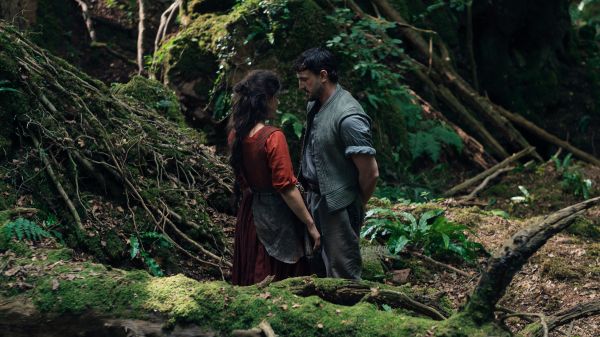
With a screenplay co-written by Chloé Zhao, one of the most sensitive directors working today, alongside O’Farrell, the filmmaker transforms Hamnet into an extraordinary film, crafting Shakespeare’s domestic world without false notes. Agnes (Jessie Buckley) is known as the daughter of the “witch of the woods,” heir to her mother’s gifts. Emerging from the forest with a large bird in her hand, she is first seen by Will (Paul Mescal) as he teaches Latin to the town’s children in Stratford. There is instant chemistry when he steps outside to greet her, but she is as cautious as she is defiant about his proximity, initially refusing to tell him her name. After a few encounters, he recognizes and admires her distinct, untamed essence, while she later describes him as someone who “has more inside him than any other man I have ever met.”
When Agnes becomes pregnant by Will, they marry despite objections and doubts from their families. Months later, she flees her in-laws’ house to deliver their eldest daughter alone in the forest. Her second labor, though, is more traumatic. Because of a torrential rain outside, her Christian mother-in-law (Emily Watson) forces her to give birth to twins—a boy and a girl—indoors. The girl is born dead, or so it seems, until she manages to breathe. Yet Agnes cannot shake a sense of foreboding. She remains vigilant over the health of Judith (Olivia Lynes), while her brother Hamnet (Jacobi Jupe) is inseparable from his twin. Will, though a passionate husband and loving father, is rarely present when needed, as he is frequently away working in London. When tragedy strikes, brought by the plague, Will arrives too late to find only one of his twins alive. This is not really a spoiler; it is the dramatic centerpiece of the story and a known biographical fact, as Shakespeare’s son Hamnet died at eleven. Shakespeare’s name is never mentioned in the book, and here it is spoken only once. Will is Shakespeare, and Agnes is the woman we historically know as Anne Hathaway.
The sober drama unfolds in three acts: the romance between its protagonists, the family tragedy that marks them, and their individual journeys to sublimate that pain, culminating in the staging of Hamlet in London. It is a complex but poignantly clear work about grief and the way it can become a primary source of creation. This is evident in the parallel scenes of Agnes and Will confronting the immediate loss of their child—first dying in her arms and later, when Will arrives, being uncovered from the sheets that shroud him. It’s a formidable challenge for any director and actors, but rawness and agony are captured here with extraordinary mastery.
The most complicated section of the material is its final stretch. Agnes decides to travel to London to see for herself the play titled with—nearly—the name of her son. Hamlet is a play about many things: a dark tale of death and revenge, but also of mourning and its bitter ramifications, and, in large part, of the things beyond what our “philosophy can dream.” Through Hamnet, we have the opportunity to see such a work with new eyes—the first eyes, to be precise. Hearing Mescal, or Noah Jupe (Jacobi’s real-life eldest brother), as the actor playing Prince Hamlet, recite lines so revered and familiar that they feel newly minted is a wonder. Even more astonishing is seeing them through the eyes and gestures of Agnes, marveling like any other audience member at the beauty, pain, and wisdom of what has been staged, but also as someone who knows what lies behind it better than anyone. Buckley and Mescal have never been better, deserving of praise among the year’s most remarkable performances. Meanwhile, Zhao has crafted one of the film highlights of the year.
Granted, Hamnet will make you cry. Surely Max Richter’s overwhelming score will help. But you will not weep because the film manipulates you like a mechanical clock. You cry as a form of relief. This is also a unique piece of art that does not depend on religious belief yet brushes against the unknown: It reveals why sometimes God (to give it a name) inhabits art, how that was true with Hamlet, and how it might also be true with Hamnet. The mystery of death and the mystery of love—here they are. As Shakespeare said, the rest is silence.







Leave A Comment