
The opening verses of Constantine P. Cavafy’s poem Ithaca are a prayer: “may the road be long, full of adventures, full of experiences.” The poem references Homer’s The Odyssey, and the verses inevitably apply to every journey, real or fictional, echoing the well-worn adage that what matters is the journey itself, not the destination. In director Oliver Laxe’s new film, Sirât, the road ahead is indeed long and packed. It is also a desert passage where both the journey and its destination grow increasingly exhausting and irrelevant. With a hypnotic effect that enraptures audiences through a nihilistic scenario, Laxe has made one of the year’s most intense and unclassifiable thrillers, and a highlight of the 63rd New York Film Festival’s lineup.
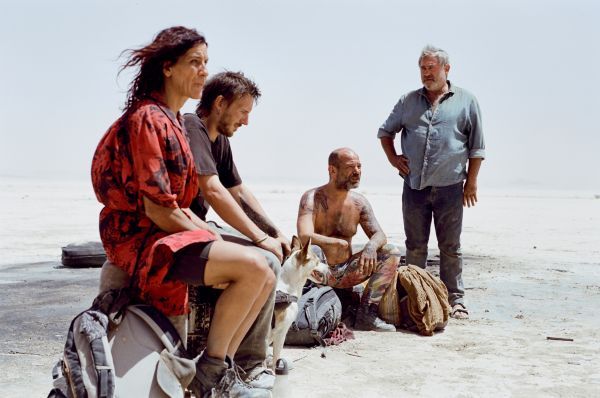
The French-born, Galician-descended director has always made films difficult to categorize—somewhere between reality and nightmare, in vibrant tension with globalization and multiculturalism. Sirât, a French-Spanish co-production, is his first where Spanish is prominent, though it also features dialogue in other languages (French, Catalan). The story begins in southern Morocco and paints a world of chaos and conflict, more post-apocalyptic than a merely end-of-the-world storyline. A band of misfits—including two men with an amputated arm or leg (the result of some war? gangrene?)—gather in the desert to lose themselves in a rave, dancing to pounding electronic music that is more noise than melody, but what a noise! (Courtesy of Kangding Ray.) These long caravans haul massive sound systems across deserts simply to find the perfect wasteland for an experience that could almost be called religious, though without a lasting epiphany. They are perhaps chasing a fleeting instant of Nirvana or a moment of glory through dance.
The title, explained in an epigraph, is an Islamic term referring to the bridge between hell and paradise that souls must cross on Judgment Day. Only the fair and fearful make it to the other side unscathed. In Sirât, that metaphorical passage of desperate souls in search of their idea of paradise is realized when they stage a rave in a vast desert. Two party crashers, Luis (Sergi López) and Esteban (Bruno Núñez Arjona), a father and son accompanied by their loyal dog, wander about handing out flyers among the ravers, searching for information on a missing relative—their daughter and sister, Mar. She too was a raver, and the family hopes that if they can’t find her, at least they’ll learn what might have happened to her.
Luis grows impatient with the endless replies of “I don’t know” and “Never seen her” from the partiers and decides to join a caravan for a journey of indeterminate miles and days to the next rave, near Mauritania. Inevitably, father and son, remaining on the search, impose a mission that doesn’t align with the rest of the group, which includes Bigui (Richard Bellamy), Stef (Stefania Gadda), Josh (Joshua Liam Henderson), Tonin (Tonin Javier), and Jade (Jade Oukid). López—one of Spain’s best and most prolific working actors—anchors a magnificent cast of non-professionals (though you’d hardly guess it from their work), real-life ravers whose presence infuses the film with authenticity.
Despite the group’s rough, ragged exterior and their initial reluctance to accept the father-and-son outsiders, they gradually reveal themselves to be softies—willing to share gasoline, food, and camaraderie. Luis too progressively lowers his defenses, aware that survival depends on mutual help. Radio reports of wars and shortcuts to avoid military patrols are enough to suggest that the travelers are unmoored, pursuing an absurd purpose. Yet even the seemingly noble quest of Luis and Esteban proves futile and desperate, driven by reckless obsession: A father may inevitably risk one child’s life to save another. Under such circumstances, incidents on the road are just a turn away from tragedy.
Full of tremor and detours, the journey Laxe depicts has no villains, monsters, or betrayals obstructing his travelers—only endless risks in the climate, the hard terrain, and the constant reminders that they inhabit a world of post-destruction, despite trying to stand apart from it. This road movie has no clear stops and a blurred destination, while a few stomach-churning sequences will leave you breathless. Tense and horrifying along the way, the film forces you to wonder: What’s the point of it all, if any? Yet the raw nerve that sustains it, the morbid atmosphere it builds, ultimately grounds what we crave from cinema: to be shocked by the worst that can happen and held by the hope—just maybe—that characters we care about will make it through.
Sirât will leave you in a state of stress and suffocation, and be warned: One scene is one of the most horrifying and nerve-racking sequences you’ll see this year, arriving just after another tragedy has already knocked you to the floor. Yet despite everything that goes wrong, the travelers persist. There is a word deeply rooted in Spanish culture that the film never mentions, but that feels inevitable: duende. Associated with flamenco, but applicable to other arts (even bullfighting), duende is that state of absolute surrender where a performer is seized by something almost divine—or demonic—transcending talent and discipline. In Sirât, we could say Laxe knows that duende comes with a terrible price for the unprepared. The misfits here may not be gifted, but they are reckless in their dance. You should never pretend to reach heaven when you already are in hell.




Leave A Comment