
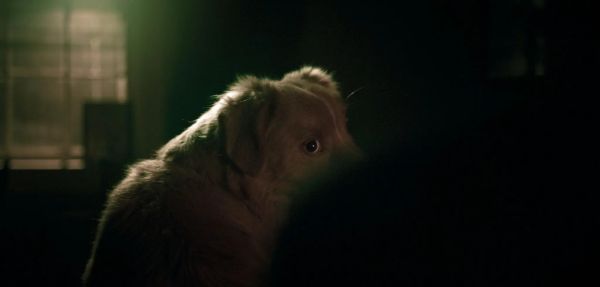
Making a horror film from a dog’s point of view could have been a high-concept, low-return situation. Clever, but what can a filmmaker really do with it? Luckily, writer-director Ben Leonberg knows his way around horror. He is an expert at building tension and misdirecting the audience, and he gets a sterling performance out of his own dog, Indy. This is not some veteran screen pooch. This is some of the best acting I’ve seen, canine or otherwise.
The plot is simple. A young man, Todd (Shane Jensen), moves into his grandfather’s old, abandoned house after a medical scare. He seems to have a hereditary lung disease that occasionally sends him into a fit of blood-soaked coughing. The house itself is notorious: No one except his grandfather (horror icon Larry Fessenden, seen in flashbacks and delivering weird home-movie monologues) has ever lasted there more than three weeks. Todd, against the strong wishes of his sister (Arielle Friedman), stubbornly thinks this is the best place for him to recuperate, and he takes along his loving, loyal, and somewhat neurotic retriever, Indy.
As soon as Todd settles in, you realize things aren’t looking good. Cramped, cluttered with nooks and crannies, and furniture covered in sheets, it is the perfect movie haunted house. Todd even needs a generator to keep the electricity going. If Indy could speak rather than bark, he would have echoed Han Solo’s famous quote, “I’ve got a bad feeling about this.”
But Indy is, as the title states, a good boy. So, he loyally and stoically sets out to make this his new home, but everywhere he sniffs, something is off. Like many human protagonists, he starts seeing things that aren’t there and begins having nightmares. As Todd’s behavior becomes more erratic and his coughing becomes worse, Indy sees more and more disturbing things. It is no surprise that something else is in the house, and that something else is not good.
Cinematographer Wade Grebnoel gives the movie a singular spooky feel and provides interesting ways to enhance Indy’s perspective and emotions. Since the canine gets down low to the ground, the camera focuses on Todd’s hands and legs, as this is what Indy sees. There is also a dog’s-eye view of the typical what’s-under-the-bed moment that is framed beautifully. Jensen has an unusual role since he is really the only onscreen human actor, and we rarely see his face as we are viewing him from Indy’s perspective. His physicality and voice sell his role, and he handles the job with aplomb.
In fact, the whole production team does first-rate work, from production designer Alison Diviney, who creates a house that no one would feel comfortable in, to editor Curtis Roberts, who manages to give each scare an extra oomph. Composer Sam Boase-Miller enhances the mood without ever being overbearing and intrusive.
But this is all window dressing without a strong lead, and Indy delivers that in spades. Not since Benji has a dog actor—or dogter, if you will—managed such a range of emotion and vulnerability. Granted, a lot of this has to do with direction and editing. Still, Indy absolutely has the “it” factor and guides us through a tightening circle of fear as he realizes whatever is going on is well beyond his canine comprehension.
Beneath the gimmick of a pooch’s perspective is a searching and sometimes searing meditation on loyalty and mortality. This pushes Good Boy over the edge of gimmick and toward art. Both Todd and Indy have an arc and a bond that is tested, while Indy, ultimately, learns something that is difficult for his human counterparts: when to let go.
Leave A Comment