
A group of teenagers waits in line outside a concrete building. As soon as they reach the doorman and show their IDs, they are immediately barred entry—minors are not allowed at the concert. This, however, does not stop them. When they see someone sneaking in through a back door, Kou (Youkito Hidaka) and Yuta (Hayato Kurihara) easily follow him inside unseen, entering the pulsing, colored light of a techno concert. They aren’t able to enjoy it for long. Cops arrive, but don’t seem to be feared or taken too seriously; the music continues to play. But this doesn’t kill the night for the teens, who soon run along the sidewalk, sneak past guards, and enter their school, where they begin to play their own techno music in a room they’ve designated as their “Music Research” studio.
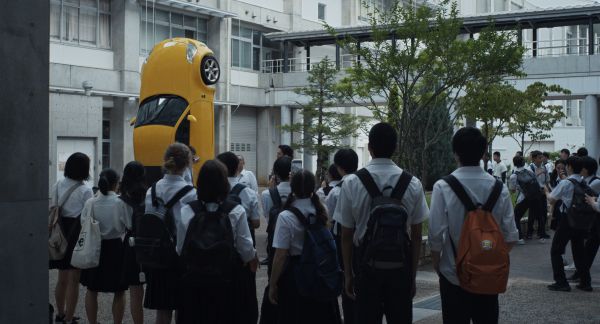
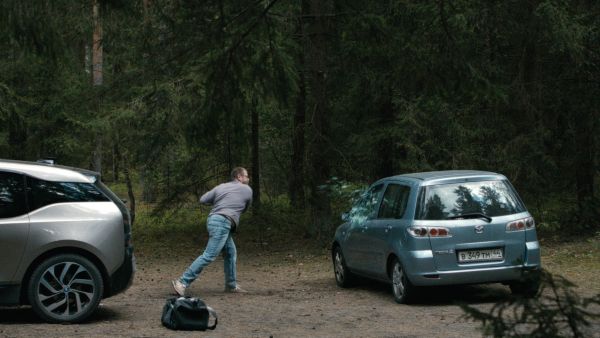
This all takes place in a very near-future Japan, where the prime minister warns insistently of earthquakes and also of “non-Japanese” influence. Protests and increasingly unrestrained police violence rage in the background. Parents, who we see fleetingly, worry about their children’s future, particularly when it comes to college, scholarships, and any mistakes that might derail them from securing a stable future. This background is somewhat at odds with the overall atmosphere of ease, the almost complete lack of supervision the high schoolers enjoy, and the sense that the most indignant adults, like the school principal, are only taken so seriously. However, after Kou and Yuta play a prank on the principal’s car, which he labels as an act of terrorism, the school installs a surveillance system capable of identifying students and lowering their grades once it catches them doing anything suspicious.
As a result, these close friends will approach a point where they will no longer be able to take their closeness for granted. This inevitable process is set against a very contemporary set of concerns—rising authoritarianism, surveillance, and environmental collapse. These are a somewhat hazy presence, not fully explored by the filmmaker, in ways that are both effective and not. Certainly, the film does convey a sense of something slowly encroaching on and affecting the teenagers as they are just trying to live their lives. But there are times when it does so in broad strokes that come close to pandering, particularly when the prime minister is concerned.
Nevertheless, this film, by and large, overwhelms with its unexpected poignance, its truthfulness, and the imagination it uses to examine its characters, along with its skillful and varied command of the medium. As soon as I finished it, I wanted to watch it again. It beautifully captures the genuine and specific love that exists within a close group of teenagers who are at once unabashedly themselves and also at the mercy of circumstances and budding responsibilities. There is a remarkable balance between silence and action, an incredible choice of visual detail, and a cunning and repeated use of the wide shot. This last technique, which frames figures dwarfed by their environment, effectively conveys that their lives will be shaped, to some extent, by the surrounding world. In different ways, the students struggle to handle impending change.
Most of all, this film insists on the presence of life and spirit even as it acknowledges loss, uncertainty, and the more frightening aspects of the future. This is perhaps best exemplified by the way the students learn to mock, manipulate, and stand up to the surveillance system. Though they are under the eye of a dehumanizing technology, they remain stubbornly human themselves. Though there is a brief glimpse of real police violence, many authority figures are somewhat nervous and pathetic, even if they have the capacity to cause damage. Indeed, there is an atmosphere throughout of kids simply let loose while the world of their elders crumbles without fuss in the background. I kept thinking of the teenagers as vegetation growing on a ruined building.
All that and I don’t feel like I’ve said enough. Yet there is much reason for hope that, in writer/director Neo Sora, a beautiful new (to me) voice has found its way to us.

Leave A Comment