

Watching a film by Joel Potrykus is a singular experience. There is simply no filmmaker quite like him. Imagine a white-trash, metal-loving David Lynch and you’d be in the ballpark. This is the man who wrote and directed his breakout film Buzzard, about a dude who, on a bet with his brother, refuses to leave the couch until he finishes level 153 of Pac-Man—even as the apocalypse unfolds outside his apartment door.
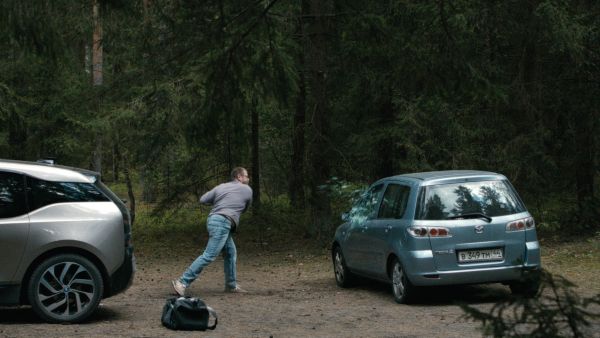
Vulcanizadora brings back two characters from Buzzard: Derek (played by Potrykus himself), a motor-mouthed, self-involved loser, and Marty (Potrykus mainstay Joshua Burge), freshly released from prison after a long stint. They embark on a camping trip initiated by Derek, who wants to shoot off fireworks and, perhaps, launch a bottle rocket into his own face—all while filming it like a Faces of Death episode (which, of course, hasn’t been a thing for decades).
As adolescent-arrested as one could get, the mid-forties Derek carries a flask specifically for his Jäger, douses himself with glow-stick juice, and belts out ’90s grunge classics. He admits to being a crappy husband and father, though this flash of self-awareness quickly curdles into self-pity as he ends up blaming his ex. You wouldn’t want to spend time with him in real life, but on screen, he’s alternately obnoxious and riotously funny. Marty appears to be the more grounded and realistic of the duo, but once you understand why they’re in the woods and what they plan to do, that illusion falls apart. These are two lost souls, devoid of hope—slackers gone feral.
The first three-quarters of Vulcanizadora plays like Antonioni by way of Kevin Smith. Shot on 16mm, it features some beautiful footage of the duo wandering through hilly woods, seemingly consumed by the nature surrounding them. It would be gorgeous—if not for Derek’s non-stop rambling. We know they’re headed somewhere and plan to do something, but we’re not quite sure what, even as Marty is seen polishing and assembling some kind of metal device. Anyone who has seen Buzzard—and that number would be a blessed few—will feel the creeping sense of unease.
The final third becomes somewhat more conventional and showcases Burge’s range as he desperately tries to get people to listen to him about what happened in the woods. I’m being intentionally vague, because this is a film that depends on a certain level of ambiguity for its full impact. In the end, Vulcanizadora is a searing exploration of despair and guilt—alternately, and sometimes simultaneously, heartbreaking and hysterical. Normally, you wouldn’t care for these social—and in one case, anti-social—misfits, but here, you do. That’s ultimately Potrykus’s great gift: humanizing the societally unredeemable.




Leave A Comment