
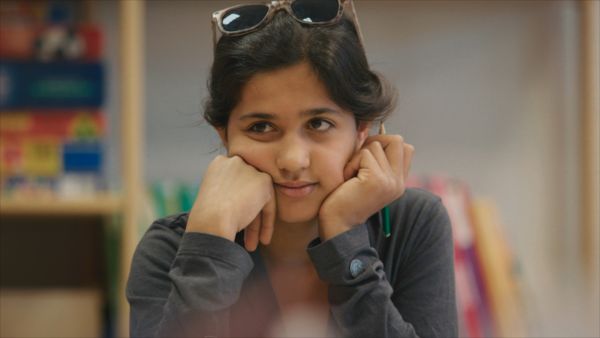
One shouldn’t need reminding that so much right-wing rhetoric has been fueled by the many refugee crises all over the world. Still, it feels like a time capsule to travel all the way back to 2015, as the new documentary One in a Million asks us to, before Brexit or the 2016 U.S. presidential election. This was not only the year when Russia intervened on behalf of dictator Bashar al-Assad in the middle of the Syrian Civil War; it was also when the filmmaking couple Itab Azzam and Jack MacInnes met Israa, an 11-year-old Syrian refugee, selling cigarettes on the streets of the coastal city of Izmir, Turkey. Her ebullient spirit charmed them, especially since it persisted in such harsh circumstances. They started filming interviews with her and her family as they prepared to make the dangerous journey to Greece and then to find asylum in Germany. They kept in touch with her and, with the family’s permission, kept filming them in small increments every year for the next decade.
Through interviews and candid observation, this documentary traces three distinct threads: Israa’s journey through adolescence in Germany, in which she alternately rejects and then embraces her Muslim roots, marries, and has a child; her mother’s discovery of independence upon the demise of her marriage; and her father’s struggle to adjust to the loss of his home, and to achieve self-awareness after living alone. These three connected threads reach a point of release when Israa and her husband travel back to Syria.
This documentary is notable both for the amount of territory it covers and the respectful distance it keeps. Though a marriage collapses in the 10 years it chronicles, the filmmakers do not place a particular judgment on any of the spouses—their domestic disputes never appear on screen. The subjects retain their dignity. We also do not see any terrors and tragedies as they occur beyond the ruined buildings in Syria and some iPhone footage of the journey in a crowded dinghy to Greece. However, 11-year-old Israa telling the camera that she saw dead bodies outside her home in Aleppo and that two children died on the long trek from Greece to Germany goes quite a long way. Also, the filmmakers have tellingly curated their selection of scenes from this 10-year project to suggest the life taking place offscreen in between. Israa’s love of hip-hop, of soccer, her attempt to plan a birthday party for her mother, and much more, all go a long way as well.
By the end, as trite as it may sound, we really do feel closer to each of the principal subjects (Israa’s younger siblings don’t talk to the camera much), and that the various forces tugging at them have been made manifest—this is enhanced by knowing we’re not seeing everything. In the various candid scenes of the family joking, of Israa playing, a genuine joy and playfulness come through without discounting the traumas of their situation. These moments elucidate the many ways that people learn to cope and, in spite of circumstances, strive to simply live their lives. No critically minded viewer could presume that this documentary encapsulates the refugee experience; but it does bring one refugee experience beautifully to light, in a film most solidly achieved.




Leave A Comment