
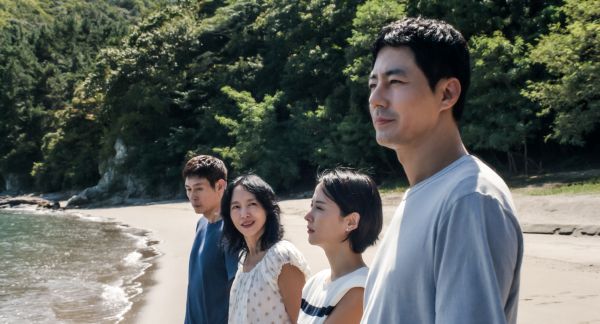
I never thought I would hear such raucous and intentional laughter from an audience during a Lee Chang-dong film. The South Korean filmmaker’s latest, Possible Love, which made its North American premiere at the Toronto International Film Festival, somewhat departs from his more austere work (Secret Sunshine, Poetry). Still, it shares hallmarks with his earlier films: well-rounded character development, an empathetic depiction of working-class life, and plenty of ambiguity, although nothing like in his last, Burning. Here, he also adds a touch of sexuality to a clash between those who have little and those who have a lot.
One could almost call this a chamber piece involving two married couples—one quite wealthy and the other just getting by—with a silent observer, the nonplussed ten-year-old son of the latter couple, Cheol (Jung Seop). The working-class 40-something couple first met when they were teenagers: Mi-ok (Lee regular Jeon Do-yeon) works for a small paper manufacturer, while husband Ho-seok (Sul Kyung-gu) has been unemployed for the last two years. He was laid off from an industrial job after his union went on strike. During the drawn-out standoff, he never crossed the picket line, though he needed the money, but stood firm.
Mi-ok and Ho-seok’s lives become the subject of the probing and ever-present camera of dilettante filmmaker Ye-ji (Cho Yeo-jeong, playing a less strident bougie than in Parasite). For her first documentary, Ye-ji aims to cover the labor situation in South Korea, with a focus on workers who have lost their livelihoods. Though she applies for grants to fund her project, one suspects her initial backing derives from her old-money husband. She went to high school with Sang-woo (Zo In-sung), but barely knew him then; his handsomeness intimidated her, and all the girls nicknamed him “Dream Lover.” They encountered each other again when they were both studying in the United States.
One senses that this is Ye-ji’s first film project, perhaps after many other abandoned endeavors: Anyone in the audience might cringe when she explains to her husband why she has doggedly invaded the lives of the lower-class couple. As a filmmaker, she believes she must “love” Mi-ok and Ho-seok, which should send off alarms. It’s one thing to do your research or to empathize with your subjects; it’s another to invite them to a drunken dinner or to your coastal estate for the weekend.
What follows includes some of the most remarkable acting this year, especially from Sul. Ho-seok has eschewed therapy and refused to be interviewed by Ye-ji. However, once he lets his guard down on camera, the floodgates burst. There is not a false note among the quartet’s interactions, which range from unwitting condescension to subtle flirtation—not to mention how men, or at least Sang-woo, may be prone to misreading women’s signals, sexual or otherwise.
Although the script features many tangents, they are really puzzle pieces that ultimately fit together. To say that what occurs among the foursome is unpredictable is an understatement. One moment may cause a quiet gasp before producing nervous laughter. In a year when the fall festivals are overloaded with bloated and aimless running times of 150 minutes or more, Possible Love’s 165 minutes are well justified. The pace flows smoothly, even as the storyline moves back and forth in time.
What is also remarkable is that this is probably the most observant feature film that has zeroed in on the current global economy, where profit and share prices trump workers’ needs and benefits, and it’s not merely paying lip service. Lee features a session of former factory workers enduring the strain of a long, drawn-out labor dispute, capturing sentiments mirrored in the notable documentaries of Barbara Kopple, especially 1990’s Academy Award-winning American Dream, centered on a tortuous strike at a Minnesota meatpacking plant.
Possible Love is part of a project to reinterpret Polish director Krzysztof Kieślowski’s ten-episode 1989 television series Dekalog. However, no homework is necessary; Lee’s work firmly stands on its own as one of 2026’s most remarkable and original films. Still, there appears to be at least one fleeting visual tip of the hat to Kieślowski: an image of a child’s hand extending out of a car window that mirrors Three Colors: Blue.
Possible Love will play theatrically in the United States on October 23 before streaming on Netflix on November 6.








Leave A Comment