
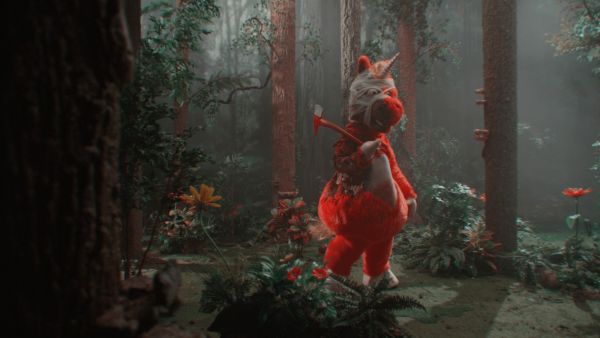
Millennials have long held a complicated relationship with Barney the Dinosaur. Many of us grew up watching Barney & Friends as kids, yet came to view the titular character’s appearance—plus the bizarre nature of his dynamic with his young supporting cast—with horror and eventual mockery as we grew older. Buddy initially seems like a play on those fears, envisioning a Barney-like show if the fantasy mascot was secretly a vindictive killer. Yet writer-director Casper Kelly goes one step further by re-creating the look of ’90s children’s entertainment before turning that pastiche inside out, delivering a horror film whose scares and campy laughs prey upon our attachment to nostalgic comfort.
Kelly is no stranger to weaponizing old genre tropes, as anyone familiar with his deranged Adult Swim special Too Many Cooks can attest. Buddy is no different, thanks to how much the fake TV show It’s Buddy resembles old PBS programs at first glance, opening credits included. For the first 30 minutes, we only see this show via individual episodes: a bright, wacky, happy-go-lucky set featuring a clubhouse, swing set, and plenty of anthropomorphic creatures like Betty Bunny (Cedwan Hooks), backpack Strappy (Patton Oswalt), and delivery train Charlie (Michael Shannon). Plus, several kids who, every episode, receive life lessons from Buddy (voiced by Keegan-Michael Key), a chipper magical orange unicorn “from a magic land” who transforms from stuffed animal to real puppet suit when his name is called. Any fear or trouble in this world can be overcome with a smile and a song, and no one, from the kids to adult characters who visit Buddy’s clubhouse, doubts his wisdom.
Midway through an episode, however, one kid decides he’s not interested in the event Buddy has planned for everyone. He is subsequently taken off the show (and quickly replaced with a new cast member in the next intro), but over time, the other kids come to the realization that something is wrong. Buddy can’t be trusted, and as Freddy (Delaney Quinn), Wade (Caleb “CJ” Williams), Hannah (Madison Skyy Polan), and Oliver (Tristan Borders) reject his formula, the more they question how everyone ended up here in the first place. Seizing an opportunity, they attempt to escape the set and head toward the mythical Diamond City, hoping it holds the key to freedom. This causes a bit of a breakdown within Buddy himself who, without spoiling too much, can’t regain his power unless the show properly rolls credits.
It’s here that Buddy shifts to the real world (complete with aspect ratio change) and we witness the supernatural damage this program has outside TV screens. Grace (Cristin Milioti) is a suburban mom who loves her husband Ben (Topher Grace) and two kids, but can’t help but shake the feeling that she’s missing something at home. This leads to a shocking emotional outburst which, in turn, diverts her attention to this TV show featuring an orange unicorn mascot. Long story short: Grace finds herself in the world of It’s Buddy while the kids attempt to leave it behind.
Buddy’s strengths lie in its worldbuilding and total commitment to this low-budget edutainment aesthetic even when it’s terrifying. The best moments within its opening act are horror scenes framed within a children’s television model, the violence and brutality juxtaposed against colorful sets and huggable characters. Kelly fully commits to this PBS Kids/Playhouse Disney–inspired camerawork, costumes, and set design even while spoofing it, and that makes the whole thing even more unsettling. The same goes for Key’s voicework, imbuing Buddy with a twisted jolly tone even when his sadistic nature becomes impossible to ignore.
Beyond Barney & Friends and Pee-wee’s Playhouse, there are clear nods to The Wizard of Oz and The Night of the Hunter when focusing on the kids’ escape from Buddy’s set prison, albeit in ebbs and flows. This creates a powerful showcase for Delaney Quinn’s Freddy as the group’s Dorothy, but the film’s back half briefly loses a bit of steam as it attempts to string the TV and real worlds together, particularly when giving a vague rationale behind Buddy’s descent into villainy. That lack of concrete detail means the storyline doesn’t waste time on exposition, but nor does it provide many answers either. Buddy eventually recovers with an absolutely gonzo final act in which no one is safe, but a deeper dive on why audiences seek comfort in nostalgic television won’t be found amid the axe murdering.
While Buddy might not be a perfect horror film, it stands out as one of the most visually and tonally impressive entries in a year full of strong horror releases. Kelly intuitively understands the ins and outs of this programming block, inviting everyone into a world that impeccably satirizes a childhood genre TV era before tearing it apart in gory fashion. It’s nostalgic in a deeply discomforting way, but that’s where the movie teaches its best lessons on how to unsettle your audience.






Leave A Comment