
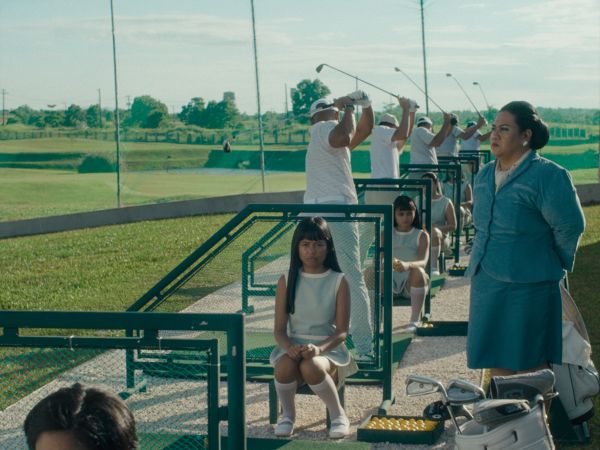
It is not far-fetched to argue that golf courses, with all their inherent artificiality and perfection, are secretly disturbing and sinister spaces. Filipiñana does not set out to be a horror film, but it is a different kind of social drama that subtly reveals the nightmares and evils that can lurk beneath the calm façade of a country club; the monsters it nurtures as a pinnacle of privilege; and the silent, eerie oppression that allows it to function properly on any given day.
Filipino director Rafael Manuel, making his admirable feature-length debut in an expansion of his previous short film, understands the golf course as a colonial inheritance whose maintenance and enjoyment depend on the inevitable distinction between master and servant, even when it is now in the hands and under the supervision of emancipated and moneyed Filipinos. Seventeen-year-old Isabel (Jorrybell Agoto) is our point of entry into this sunny, sweltering playground of class division, and an immediate moral and empathetic anchor in what often unfolds as a cold and distant film.
A newly hired “tee girl” who has moved from the countryside to the city, Isabel struggles to adapt to this closed universe of unspoken rules and implicit prohibitions. That is to say, there is still a streak of rebelliousness and carefree irreverence in her that needs to be polished away, in contrast to the veteran girls, who know how to remain as invisible as they are efficient at their jobs. Their tasks include remaining on their knees beside the patrons as they practice their swings and placing a new ball down as soon as the previous one has been launched into the air.
Somewhat reckless and disobedient, Isabel explores and ends up in spaces where she shouldn’t be, such as the reception and ballroom areas where mostly untouched food is served. Meanwhile, club president and director Dr. Palanca (Teroy Guzman) runs the place smoothly, confident that nothing will disturb the expected peace and customary enjoyment of the premises because there are always workers in the shadows—or as much in the shadows as they can be in broad daylight—making sure everything runs properly. Meanwhile, the storyline focuses on another young girl: discreet and observant Clara (Carmen Castellanos), the American niece of Renato (Carlos Siguion-Reyna), owner of Golf Depot, who is making sure that her visit is enjoyable enough to lure her with the possibility of staying and working in his company.
Isabel and Clara barely cross paths, but they offer divergent perspectives on being outsiders. For Clara, who probably takes her own privileges for granted, the dynamics of this world feel somewhat uncomfortable and strange, but she will eventually test how different she really is from her peers when forced to choose between what is right and what is convenient. For Isabel, there is a gradual realization that inequality goes beyond what she can or cannot do as a worker; it is also about how the obedience of someone who does their job properly can often amount to complicity.
Although the film takes its time getting there over the course of its 100-minute runtime, which feels longer and denser than it seems, it eventually transitions from a contemplation of a day in which nothing happens to one in which a great deal has happened, wrapping things up in a quietly terrifying manner. The less revealed about its converging climaxes, particularly the distinct narrative trajectories of Isabel and Clara, the better to preserve the clear intention of the director and screenwriter behind a film that does not seek to offer easy answers or solutions. In any case, it is worth praising the confidence with which Manuel brings his debut to a successful conclusion, avoiding beginner’s excesses in the narrative and visual execution of his ideas.
In its opening minutes, Manuel’s film offers a portrait of a city afflicted by water shortages and temperatures high enough to bring anyone close to fainting, only to move, with delicious irony, to the sprinklers wasting that desperately needed water across Dr. Palanca’s golf courses. From there, the omniscient camera never strays far from the colorful gardens or lobbies where the rich are always enjoying themselves. This astute portrayal allows barely a few seconds of direct ugliness to peek through the margins of its pristine, aseptic little world of complicit or resigned inequalities. It becomes increasingly chilling and anxiety-inducing during its final third and right through the last second of its end credits. (Like in Michael Haneke’s Caché, you should stay until the end.) It’s an upsetting conclusion, and should be, if you’ve been paying active attention throughout the deliberately lethargic journey.
Prepare to keep your senses alert, because Filipiñana avoids spoon-feeding with easy political premises. Instead, it is a slow burn that challenges our patience and attention, tempting our capacity to be seduced by beautiful images while the most horrible and cruel elements rise to the surface.







Leave A Comment