
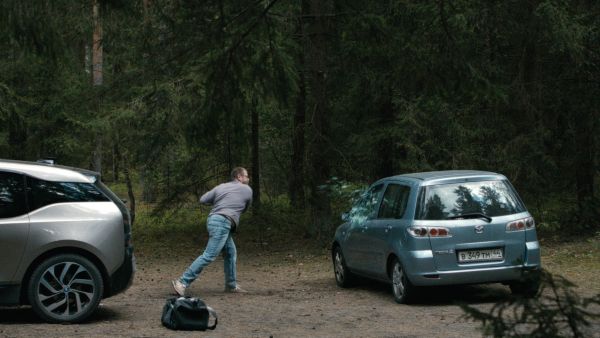
How to Divorce During the War is a tale of a marriage falling to unhappy pieces, its aggression mirrored by Russia’s invasion of Ukraine not far away. Director Andrius Blazevicius’s film won the Directing Award: World Cinema Dramatic at this year’s Sundance and earned a spot as Lithuania’s Academy Award submission for Best International Feature, and the film lives up to its accolades.
From a seemingly mundane divorce scenario, Blazevicius has devised a slow-burn character study whose bleakness is tweaked by surprises and leavened by sly humor. Wisdom too—the filmmaker deeply understands his flawed protagonists and gives them space to work through their confused emotions. The film may also offer a tart commentary on something much bigger and more dangerous than a marriage gone wrong.
Many directors, from Federico Fellini to Woody Allen, have reveled in florid dialogue to diagram the collapse of the marriage bond. Blazevicius, of course, deploys dialogue too, but offers silence as a clue and counterpoint. The storyline begins with a sequence of Vytas (Marius Repsys), whom we will get to know as a blocked filmmaker turned househusband, tidying up the comfortable, drab apartment he shares with his wife, Marija (Zygimante Elena Jakstaite), and their tween daughter, Dovile (Amelija Adomaityte). Vytas cleans meticulously and arranges lovingly, enjoying this solitary pursuit perhaps too much.
Then the director uses confinement and body language to convey the couple’s emotional turmoil. In an explosive exchange a few minutes later, the motionless camera records Marija and Vytas arguing in their car, their glum faces dimly visible through the windshield. She’s bored and sick of the marriage: “Life was supposed to be exciting! … You used to be cool, smart, and talented!” He’s caught unawares by her betrayal, then stung and miserable. The cramped, dark interior of the auto mirrors the entrapment of a union that one of the parties wants to escape. In a tightly framed scene by a doorway, Blazevicius moves bodies masterfully when Vytas has to tell his elderly parents that he’s moving back home. We can’t see his mother weep, but we can tell from her bent posture that she’s stricken. Vytas’s attempts to shrug the situation off can’t cover up his alarm and misery as he tells her not to cry. “How can I not cry?” she plaintively asks. The result is heartbreaking.
As Vytas and Marija uncouple, Russia invades Ukraine. Not only do the rattled spouses have to navigate their separation, but they also have to respond to a nearby geopolitical crisis. Their reactions reveal the limits of their personalities to cope. Marija, a social media producer whose goofy output Vytas mocks as created “for dumb idiots to make them dumber,” is headstrong and impulsive. She resigns from her company because of its ties to Russia, then invites Ukrainian refugees to live in her flat—decisions that will introduce complications and even more anger into the life of an already angry person. Vytas struggles with money and butts heads with his parents, old-time ex-communists who favor Russia in the conflict. He demonstrates support for Ukraine with acts of good-guy, performative activism; when a counterprotester at a rally shouts at him, “Can’t make any films so you’re lying around protesting,” we feel guilty but kind of agree with the heckler. Meanwhile, their daughter is miserable and acting out at school.
Vocal Marija and soft-spoken, round-faced Vytas look very different on the surface, but as the film goes on, we see they are more alike than we thought. Both have explosive ways to deal with crisis, only Vytas carries out his clandestinely (or so he believes). Both channel their discontents into politics, only to find those discontents amplified. To their credit, both try to be good parents. And both conceal secrets, with Marija’s culminating in an egocentric and petty act. Is it any wonder that these two find that life is harder apart than together?
Although their faults can be annoying, it is hard to be angry with the couple. They are just caught up in humanity’s universal drift toward sad misunderstandings and bad decisions. The unmoving camera, natural light, and scenes with a slightly repressed natural rhythm underscore a certain banality in their situation. For all the hum of crisis in the air, the pair are not even in the thick of battle in Ukraine—they’re in Lithuania, with an air of anticlimax seeping in as the war and their own struggles drag on. As Marija says, “The war is close, but it’s not here.”
A battle of a kind has erupted in their hearts, though, with the instigator never reckoning with or taking responsibility for the one-sided rupture that led to so much pain. Though it’s a movie not given to big statements, it offers a metaphor: In love, as in war, do the heedless tramplers of others get away (mostly) scot-free? How to Divorce During the War uneasily sleeps on this question, as does the viewer.






Leave A Comment