|
Reviews of Recent Independent, Foreign, & Documentary Films in Theaters and DVD/Home Video
KATYN
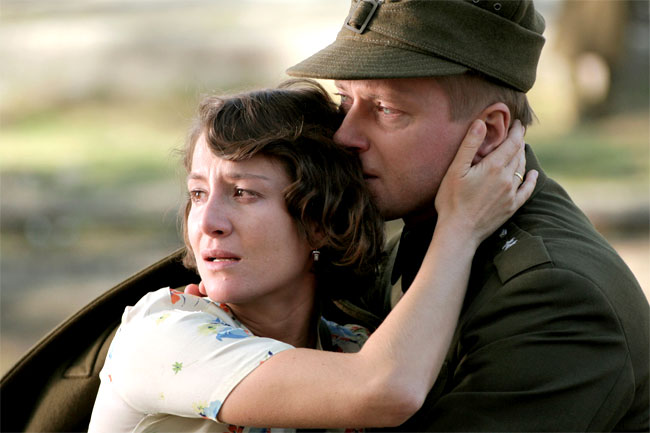
In the opening sequence, frightened families—women, children and the elderly—crowd a bridge on September, 17, 1939, fleeing the Nazis from the west and panicked by the oncoming Red Army from the east. The Hitler-Stalin Pact has just been signed, secretly handing over eastern Poland to the Soviet Union. Amidst the chaos, Anna (Maja Ostaszewska), a mother on a bike with her young daughter, frantically searches for her husband, Andrzej (Artur Zmijewski), a captain in a reserve regiment. He and his fellow officers are just as confused on why they are being rounded up by the Red Army as prisoners of a war they didn’t know had been declared. Anna pleads with her husband to desert, but he insists on loyalty to his troops. He is one of thousands of Polish soldiers, as well as the entire officer corps of the Polish army, taken away by train. Red hammers and sickles replace the Polish flag in the east, and the regiment’s home city of Kraków is smothered in Nazi banners, where the university faculty is quickly dispatched by the Gestapo’s boot. The film switches back and forth between the imprisoned men and the stunned families left bereft at home, where truth is also a casualty of war as they struggle to find their husbands, fathers, sons, and brothers, over months and years. What actually happened in the Katyn Forest isn’t recreated on screen until the closing horrific scenes. The film’s centerpiece is a fascinating look at the power of propaganda as Wajda guides contemporary viewers through the thicket of manipulated history. After the Nazis broke their alliance with Russia in 1941 and marched east, they discovered the mass graves in the Katyn forest and seized the opportunity to promulgate anti-Soviet sentiment by filming the corpses for international forensic examination, gruesome footage that Wajda uses. Years later, the Communists are seen displaying the same footage—but with a new narration claiming the events took place in 1943 and so were committed by the Nazis, who were then occupying the region. Those same bodies have to be dug up a third time for the truth to start coming out of Russia in 1990. (Stalin’s henchmen and their over 20,000 Polish victims are still being identified.) An angry and sorrowful film made possible by Poland’s democracy, Katyn does lack some of the subtlety that Wajda employed when he operated under Communist censorship. One of his intriguing hallmarks has been initially problematic protagonists, such as the obnoxious woman filmmaker in Man of Marble and the hack milquetoast journalist in Man of Iron. The closest here is friendly lieutenant Jerzy (Andrzej Chyra), who justifies joining the Red Army in order to survive as a witness. (Handsome with piercingly blue-eyes, Chyra looks so much like Daniel Craig that one could be confused that he’s fighting in that other forest in Defiance.) Wajda’s sentimental portrayal of the proud, patriotic women who risked all by insisting on honoring their relatives’ memories can be sympathetically understood as a tribute to his mother, who always refused to believe that his father was really on the list of Katyn victims. Based mostly on a novel not yet available in English, as well as diaries and letters, the film’s many interconnected characters do seem like too noble representatives than real individuals, but secondary characters add color by portraying the hypocritical atmosphere of ambition and cynicism after the war—a general’s former maid who now rides in the Communist Party’s limousine or the bald Auschwitz survivor eager to buy long blonde tresses for a wig. Wajda’s crowd scenes are always
exquisite (as in another post-war look, Landscape After Battle).
The beautiful cinematography of Paweł Edelman (The
Pianist) swoops his camera from on high, panning intense friezes of refugees, soldiers, and corpses, and back across horizons of
despair. With
exceptional commitment and artistry, Wajda’s politically engaged
filmmaking continues to vividly bring one country’s tortured travails
through the 20th century to the world’s attention.
Nora Lee Mandel
|



 Over six decades, master director
Andrzej Wajda has returned time and again to the 1940’s as the hinge of
Polish history, exploring from different angles what cost Poland its
freedom after World War II. Now in his eighties, Wajda caps a
cinematic career by targeting the big lie with
Katyn.
Over six decades, master director
Andrzej Wajda has returned time and again to the 1940’s as the hinge of
Polish history, exploring from different angles what cost Poland its
freedom after World War II. Now in his eighties, Wajda caps a
cinematic career by targeting the big lie with
Katyn.